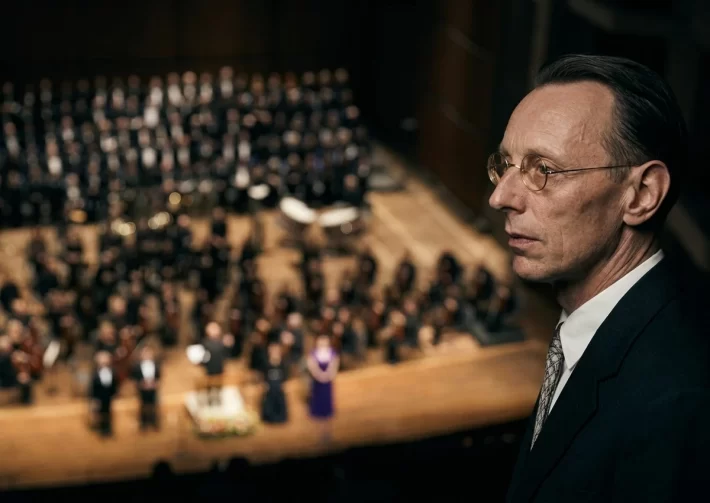
In the mid-1930s, Carl Orff came across a collection of medieval songs and poems from the Bavarian monastery of Benediktbeuern, published in 1847 under the title Carmina Burana. With the help of Michel Hofmann, a law student, he chose 24 of the poems, most of them in Latin, with a few in medieval German and Old French. The work he composed on them was first performed, fully staged, at the Frankfurt Opera in 1937. Orff then told his publisher that everything he had written before could be destroyed, because his collected works began here.
The cantata opens and closes with O Fortuna, a lament addressed to Fortune and her ever-turning wheel. In between come scenes of spring, of drinking in a tavern, where a roasting swan sings of its fate, and of love. Orff scored it for a big orchestra with two pianos and heavy percussion, a large chorus, a boys’ choir and three soloists, and built the music on rhythm and repetition. Recordings differ in speed, in how raw or polished the chorus sounds, and above all in the soloists.
Here are The Classic Review editorial team’s recommendations for the 10 best recordings of Orff’s Carmina Burana.
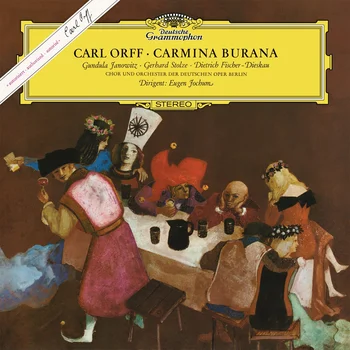
Orchestra & Chorus of the Deutsche Oper Berlin, Eugen Jochum
Eugen Jochum’s 1967 recording, made with Orff’s approval, remains the reference version of Carmina Burana. It was his second recording of the work, after a mono version in the early 1950s. He cares more about the humor and lyricism of the music than about sheer power, and his quick tempos never feel rushed. The soloists are outstanding: Gundula Janowitz, Gerhard Stolze as a vividly drawn roasting swan, and Dietrich Fischer-Dieskau, who is at home in every part of the baritone’s wide-ranging role. The one weakness is the sound, which has aged: the quiet choral passages are slightly distant.
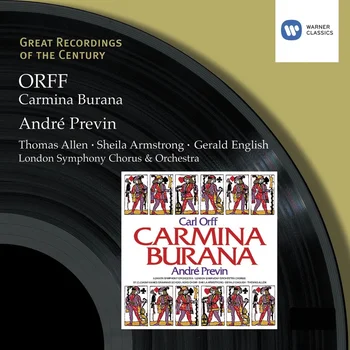
London Symphony Orchestra & Chorus, André Previn
Compared with Jochum’s, André Previn’s 1974 recording has more rhythmic spring, even though a few of its tempos are on the slow side. It is the first of his two recordings of the work, made almost twenty years before his live version in Vienna. The London Symphony Chorus sings with a wide range of color, though not always perfectly together, and the boys’ choir is excellent. Of the soloists, Thomas Allen is a superb baritone, as convincing in the quiet songs as in the loud ones. Sheila Armstrong is graceful in the soprano solos, but not quite Janowitz’s equal.
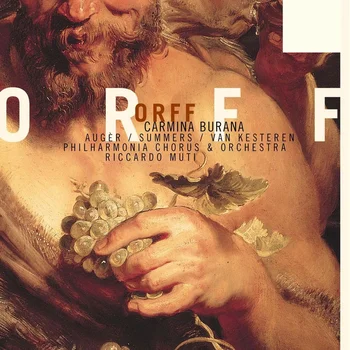
Philharmonia Orchestra & Chorus, Riccardo Muti
No recording on this list is more dramatic than Riccardo Muti’s 1979 version with the Philharmonia Orchestra and Chorus. The chorus is sharp and tireless, the brass fanfares ring out, and the tam-tam strokes land with real force. Muti keeps the intensity high from start to finish, so subtle shading is rare and the whole can feel relentless. The sound, too, is bright and slightly hard. Among the soloists, Arleen Augér is the highlight: her Dulcissime is pure and effortless at the very top of the soprano range.
New Philharmonia Orchestra & Chorus, Rafael Frühbeck de Burgos
There is a strong sense of theater in Rafael Frühbeck de Burgos’s 1965 recording, his only one of the work. His tempos are flexible, the performance sounds spontaneous, and the chorus keeps perfect time. Frühbeck de Burgos does less with the orchestral detail than some conductors. The sound is a weakness, too, turning edgy and distorted at the loudest climaxes. Two of the soloists stand out: Lucia Popp sings sweetly, and Gerhard Unger treats the swan’s lament gently, as a real song rather than a joke.
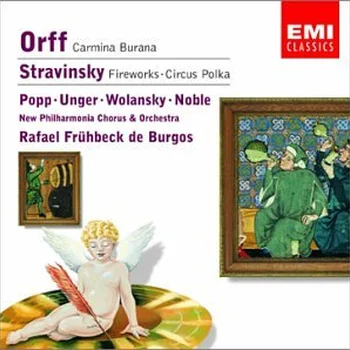
Leipzig Radio Symphony Orchestra & Chorus, Herbert Kegel
Where Muti stresses attack, Herbert Kegel puts the singing first. His 1974 recording, a remake of his version from the 1960s, has the Leipzig Radio Chorus in beautiful voice throughout. The big choruses have less force than in other recordings, and the tension slackens in places. Karl-Heinz Stryczek is a fine baritone soloist.
Philadelphia Orchestra, Eugene Ormandy
Eugene Ormandy’s 1960 recording with the Philadelphia Orchestra belongs above all to the Rutgers University Choir. The singers have a full tone and very clear words, and their pleasure in the music is obvious from start to finish. For its age, the sound is remarkably good.
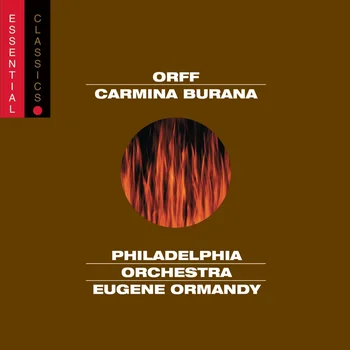
Boston Symphony Orchestra, Seiji Ozawa
This 1969 Boston recording is the first of Seiji Ozawa’s two versions of the work. The soloists are uneven: Evelyn Mandac’s soprano turns shrill at times, and the tenor, Stanley Kolk, sounds held back. The New England Conservatory Chorus is another matter, singing with plenty of gusto. Ozawa keeps the energy up, yet in several sections he chooses slower tempos than usual, so more of the orchestral color comes through.
San Francisco Symphony & Chorus, Herbert Blomstedt
The San Francisco Symphony and Chorus play and sing with great precision on Herbert Blomstedt’s 1990 recording. The soloists are less impressive than the chorus and orchestra. At times, too, all that care makes the performance seem cool. Even so, few recordings let you hear so much of Orff’s orchestra, and the brass and percussion sound full and heavy.
Berlin Philharmonic, Simon Rattle
In this live concert from 2004, Simon Rattle and the Berlin Philharmonic bring the work closer to Stravinsky than most performers do. O Fortuna is taken very fast, and the percussion is played at full strength. The Berlin Radio Choir sings with real expression. At the center of the performance is Christian Gerhaher, who strains in the highest falsetto passages but gives every baritone song a strong character of its own.
Tonhalle-Orchester Zürich, Paavo Järvi
Without any of the bombast the work often attracts, Paavo Järvi’s 2022 recording with the Tonhalle-Orchester Zürich is light and transparent. It has plenty of drive, and the spring and love music is sensuous. Russell Braun sings the love songs ardently, but the soprano, Alina Wunderlin, takes In trutina a little too quickly. Next to Jochum or Frühbeck de Burgos, the performance can seem less individual, but it shows how lively the work can sound when nothing is exaggerated.
Top image ©️ The Classic Review, AI generated