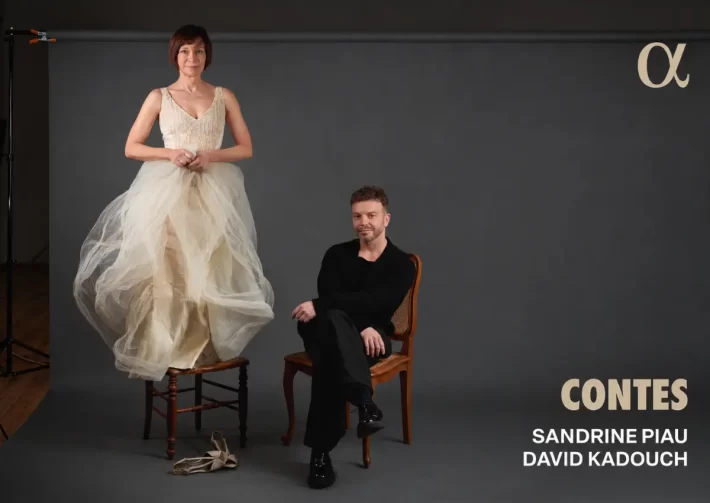
While the title of Sandrine Piau and David Kadouch’s new project translates to “tales,” the performers in their accompanying interview note the complexity of their theme: light and dark tales, they observe, follow us into adulthood, creating a multidimensional way to tell stories.
The offerings here are indeed diverse: Piau plays to her strengths in French art song but also extends her range to include songs by Wolf and Shostakovich.
Jeanne Bernard’s Trois chansons de Bilitis opens the program; this set is not to be confused with Debussy’s more famous cycle. The songs themselves are based on entirely different poems from Pierre Louÿs’ collection, with Debussy choosing themes of sensual love and nature. Bernard, on the other hand, elects to depict scenes of childhood and innocence. It’s a shame that her version is so often overshadowed, as it is a delightful cycle.
Piau’s vocal timbre and temperament fit beautifully, breathing much vitality into the songs. Les petits enfants (track 1) is effusive and imaginative, while Les contes (track 2) takes a gentler turn. Several times, the textures thin to a single line in each part, and the duo creates a beautiful tenderness in such moments.
Reynaldo Hahn’s À Chloris (track 4) draws unmistakably upon Baroque styles. Piau’s familiarity with this repertoire through her extensive Baroque discography serves her well: her vocal control is not just meticulous but reveals an exquisite level of clarity. In some ways, I found that her voice takes on an almost flute- or recorder-like quality. Kadouch’s accompaniment possesses a similar pristine quality but also brings a sense of placid warmth.
Wally Karveno’s La robe de lune (track 5) is a quirky waltz that vacillates between the lush and bold and the quiet and introspective. The performers capture the spirit of each character without losing the anticipation the text conveys. The ending, though, offers a moment of unexpected irony: the warmth the duo evokes at the arrival of the major key actually speaks to the saddest moment in the poem.
La fille aux cheveux de lin (track 6) gives Kadouch a solo moment. Consistent with his duo playing, his style is uncontrived and speaks directly to the listener. However, parts of Debussy’s prelude could use a little more time to let the harmonies bloom or for the color changes to work their full magic.
Maurice Ravel’s Cinq mélodies populaires grecques is a series of five vignettes of traditional Greek life and features some of the most vivacious and sensitive performances from the duo. The excitement of a wedding morning comes through Piau’s breathy phrases and Kadouch’s delicate chimes, vividly reminiscent of wedding bells in the distance.
The words of Là-bas, vers l’église (track 8) may be relatively simple, but the performance says otherwise: Kadouch’s opening chords create a nuanced sparkle while Piau brings a new level of expanse and resonance to her lines. The folk element is alive and well in Quel galant m’est comparable (track 9) but without losing the refinement of Ravel’s musical style.
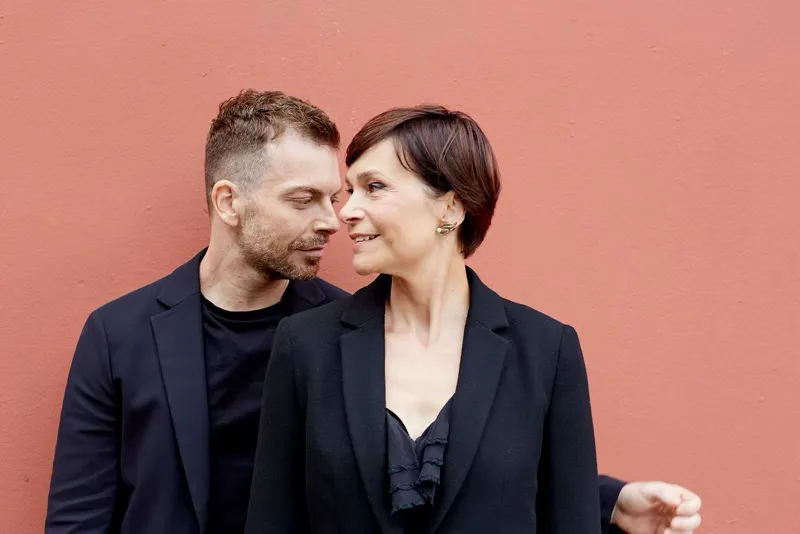
Sandrine Piau and David Kadouch. Photo © Sandrine Expilly.
Among the non-French repertoire, Hugo Wolf’s Die Geister am Mummelsee (track 13) from the Mörike-Lieder shows a different side of Piau’s vocal profile. Up to this point, her light coloratura range has featured prominently, but this song brings out a warmer, lyric quality. It holds up very well even over Kadouch’s thicker accompaniment, which also allows the pianist to unleash a fuller, more powerful sound we’ve not yet heard.
One of the best selections on the album is Richard Strauss’ Wiegenlied (track 14), whose ebullience is captured in the piano part that mimics flowing water. Meanwhile, Piau assumes a presence that draws on both her strengths—high-register clarity and middle-register glow—to create a highly expressive narrative.
Shostakovich’s Ophelia’s Song (track 26) is the album’s emotional low point, though it comes a little too late in the program. Still, it’s a welcome contrast to the lighter songs. The most striking difference from the other songs is the scoring for voice and cello. The poignancy of the string instrument brings an added level of desolation to the music. Piau once again turns to her lyric timbre here in an interpretation that is both soulful and devastating.
Contes is yet another well-programmed and thoughtfully rendered album from Piau and her collaborators, and one that showcases her expressive versatility. Warmly recommended.
Recommended Comparisons
Ravel: Cinq mélodies populaires grecques
Sabine Devieilhe, Alexandre Tharaud | Gerald Finley, Julius Drake | Mady Mesplé, Dalton Baldwin | Gérard Souzay, Dalton Baldwin