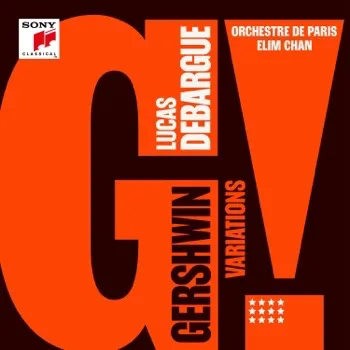
Review: Gershwin Variations – Lucas Debargue
In this Gershwin-centered program, pianist Lucas Debargue plays a 2.87-meter piano by Stephen Paulello. It is a wonderful instrument with a deep, resonant bass and a bell-like clarity in the upper registers, well suited to this repertoire. The album treats us to one of the best performances of the Concerto in F in recent memory. Debargue brings such infectious dynamism to the piece that the Orchestre de Paris and conductor Elim Chan are happily swept away by his energy. Across all the pieces on this album, Debargue makes the music sound entirely improvised.
The concerto is so successful that one might hope the album would include Rhapsody in Blue in its full orchestral form. Instead, we are given the solo piano version, but it is played so convincingly that one soon forgets about the lack of an orchestra.
The second disc is dedicated to Debargue’s own compositions: the 12 Virtuosic Etudes on Gershwin’s Songs (2025). These etudes display remarkable piano technique and an intimate familiarity with all the instrument’s intricacies. The final etude is a brilliant set of 20 variations on “Summertime.” This is a delightful, excellently engineered album.
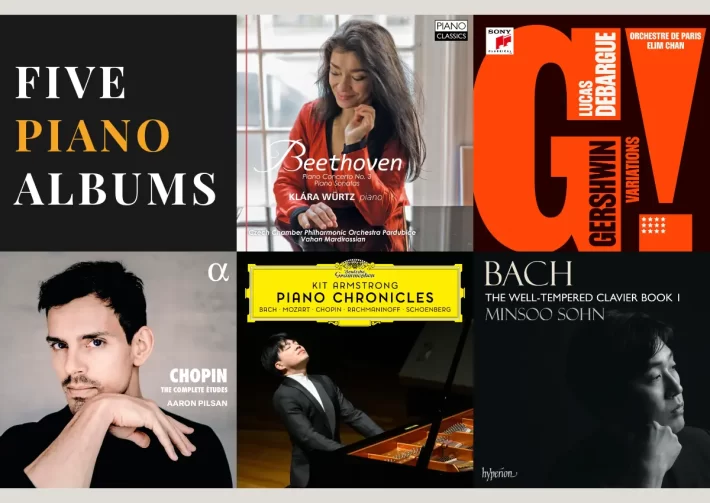
Gershwin Variations – Lucas Debargue, Orchestre de Paris, Elim Chan – Sony Classical 19958404642
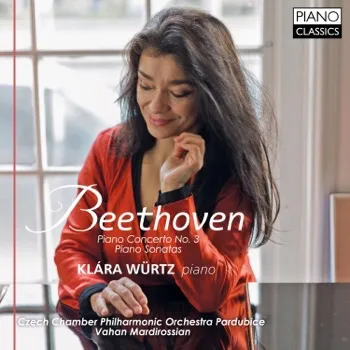
Review: Beethoven: Piano Concerto No. 3, Piano Sonatas Nos. 8 & 14 – Klára Würtz
Until recently, Klára Würtz had only released chamber works by Beethoven (including the violin and cello sonatas, as well as the Quintet for Piano and Winds), with solo works absent from her discography save for the Für Elise bagatelle. These recordings were originally featured in the 34-CD box set Celebration (review) and are now being released separately. The sonatas were recorded in 2020, while the concerto dates from 2023.
The unquestionable highlight of this release is the Moonlight Sonata, a performance that combines delicacy, charm, and fierce temperament in the third movement. The famous Pathétique Sonata is treated a bit nervously in the outer movements, though Würtz is superb in the central Adagio.
In the Piano Concerto No. 3, there is a slight inconsistency in the interpretation of the first movement (including an unfortunate wrong bass note at a crucial moment around 11’15”). The woodwinds and timpani of the Czech Chamber Philharmonic Orchestra Pardubice under Vahan Mardirossian are highly responsive, yet even in a chamber-sized ensemble, one wishes the strings had more presence.
As in the Pathétique, Würtz’s true strengths reveal themselves in the slow movement, where she proves to be an expert in voicing the slow chord progressions and sustaining the main musical lines. Like András Schiff and Alfred Brendel, she finds humorous elements in the finale. Würtz admirers shouldn’t hesitate, and I will certainly be returning to this version of the Moonlight.
Beethoven: Piano Concerto No. 3, Piano Sonatas – Klára Würtz, Czech Chamber Philharmonic Orchestra Pardubice, Vahan Mardirossian – Piano Classics PCL10290
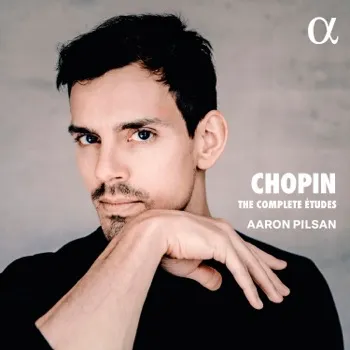
Review: Chopin: The Complete Études – Aaron Pilsan
Following his recording of both books of Bach’s Well-Tempered Clavier (review), Aaron Pilsan returns to the Alpha label with another complete set: Chopin’s Études.
It has been a while since I’ve heard the first Op. 10 Étude played with such harmonic sensitivity and exquisite tone coloring as we get in this new performance. Yet as a complete cycle, these are not quite as exciting as the reference performances by Perahia, Pollini, or Zayas, nor do they fully match the recent thrilling accounts by Lim, Chochieva, and Rana.
Some of the Études are intentionally lighter and more transparent than we usually hear—such as Op. 10 No. 6 and the “Revolutionary” (Op. 10 No. 12)—while in other slower Études, I wished Pilsan had taken more time to let the music breathe.
He has a keen ear for inner voices, however. He highlights fascinating details in Chopin’s counterpoint, most notably in Op. 25 No. 5, and demonstrates highly skillful, nuanced pedal work in the notoriously difficult thirds Étude (Op. 25 No. 6).
Chopin: The Complete Études – Aaron Pilsan – Alpha Classics ALPHA1270
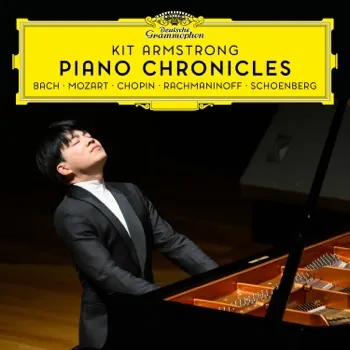
Review: Piano Chronicles (Live) – Kit Armstrong
This mammoth program covers the history of piano music from the 17th century all the way to contemporary works. The 73 tracks were recorded live at the Tokyo Bunka Kaikan Small Hall across three separate concert dates (April 4, 6, and 8, 2023) as part of the Spring Festival in Tokyo.
Armstrong is superb in the early pieces by Byrd, de La Guerre, and Couperin, which are rarely heard on a modern piano. His Bach is highly emotional and features some very distinct, occasionally extreme, tempo choices. A great joy of this set is hearing the cross-influences between composers: for instance, listening to C.P.E. Bach’s Fantasia right after the earlier Baroque works makes perfect developmental sense.
The Classical repertoire by Mozart and Haydn is well played, even if I occasionally found myself disagreeing with Armstrong’s overly slow tempi for the Andante movements. His Chopin is relatively straightforward, as is his Rachmaninoff (Corelli Variations), which sometimes sounds cautious and under-pedaled. Surprisingly, I thought this direct, unmannered approach works very well in the French repertoire, bringing an appealing clarity to Debussy and Fauré.
The piano sound is consistently lovely, as is the live recording quality. Deutsche Grammophon is releasing this fascinating set in digital format only (including Dolby Atmos), though it is a shame it does not include a digital booklet to guide listeners through this massive journey.
Piano Chronicles (Live) – Kit Armstrong – Deutsche Grammophon 4866299
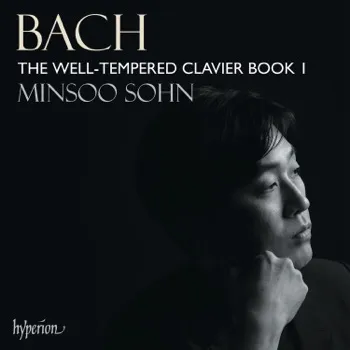
Review: Bach: The Well-Tempered Clavier, Book 1 – Minsoo Sohn
Minsoo Sohn’s interpretation of Bach’s The Well-Tempered Clavier, Book 1 on the Hyperion label leans into a deeply retrospective approach. Compared to brisk, contemporary readings like Pilsan’s, Sohn opts for slower tempos across most preludes and fugues, uses fewer ornaments, and applies a more generous amount of sustain pedal. His playing harks back to the grand tradition of late 19th- and early 20th-century pianists, echoing the aesthetic of Edwin Fischer and Rosalyn Tureck.
Despite this old-school romanticism, Sohn remains acutely mindful of period and stylistic considerations. Each line is meticulously judged, ensuring that the counterpoint never becomes overly blurred or loses its thread, even within the most complex multi-voice fugues.
Sohn plays a Steinway & Sons grand, recorded at Schloss Elmau, and the instrument’s modern dynamics are carefully controlled and never sound excessive. As Sohn himself notes, performing this Baroque masterpiece on a modern piano is akin to playing a “transcription,” requiring a careful balance of imagination and open-mindedness.
The recording unfolds as a spiritual journey rather than an academic exercise. It offers a profoundly pleasurable and moving listening experience that succeeds precisely by avoiding any hint of didacticism.
Bach: The Well-Tempered Clavier, Book 1 – Minsoo Sohn – Hyperion CDA685012