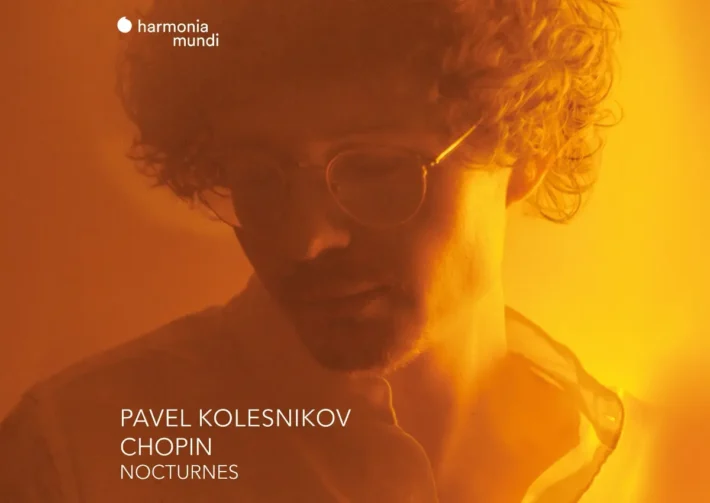
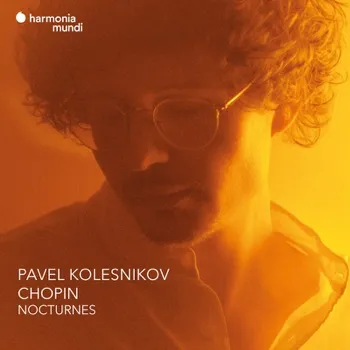
In the booklet for his complete recording of Chopin’s Nocturnes, Pavel Kolesnikov writes a short, poetic and often philosophical reflection on each piece. Yet for all the attention he gives each nocturne on its own, he seems to be after a larger narrative. Chopin left two versions of the C-sharp minor Nocturne, Op. posth., and Kolesnikov records both, placing one at the start of the first disc and the other near the end of the second. He also sometimes links the two nocturnes within an opus, so that they sound as a pair rather than as separate pieces.
Kolesnikov’s individual style is apparent from the early Nocturnes. Where many recordings put the bel canto that defines so much of Chopin’s writing at the center, he brings it out only where he feels it belongs. The result is a wide range of sonorities, from nearly weightless to boldly dramatic, and his voicing can switch quickly from light to deep, from mellow to shallow and brilliant. Moving between these sounds is what makes Op. 9 No. 1 (CD 1, Track 2) so nuanced yet dynamic. Op. 9 No. 3 (CD 1, Track 4) shows a different side: it sounds light, playful and spontaneous, with the faster passages fleeting and improvisatory.
That spontaneity goes beyond surface charm. Op. 15 No. 3 (CD 1, Track 7) is one of the few nocturnes Chopin linked to a program, Hamlet, though the music seems far removed from the play’s darkness. Kolesnikov hears Ophelia in it rather than Hamlet and plays it as her portrait: his melodic lines capture her demure, placid nature, while lithe, subtly sparkling passages reveal a more capricious side.
Kolesnikov plays a Yamaha CFX concert grand, an instrument that typically has a lot of presence. His pedaling and projection take it in another direction, combining the intimacy of the salon with a dreamlike haze. The pedaling itself is unusual, even strange. Several pieces, among them both Op. 27 nocturnes and Op. 32 No. 1, are heard in a wash of sound that often turns blurry (and is certainly not marked in the score). The pedal is not his only liberty with the text either. Kolesnikov can be attentive to the score, but in a few places he adds notes, playing a single note as an octave or adding a bass.
Within that haze, the well-loved D-flat major Op. 27 No. 2 (CD 1, Track 9) still floats beautifully, even in its most charged moments. It may not have the brighter, vocal shine of Pollini’s 2005 recording, but it has the tenderness and sensitivity heard throughout the album.
Op. 37 is built on contrast. In overall character the two nocturnes are like night and day, but listen closely and there are telling contrasts within each as well. In Op. 37 No. 1 (CD 1, Track 12), the minor-key sections move thickly and purposefully, almost as if Kolesnikov were pushing against a current. In the brighter sections the current eases, and the music moves forward. In its G major sister, Op. 37 No. 2 (CD 1, Track 13), the reverse is true: Kolesnikov interrupts the cheerful, chirping melody with a much deeper sostenuto section, colored by unexpected harmonies as the music moves into the instrument’s lower register.

Pavel Kolesnikov. Photo © Eva Vermandel.
The C minor Op. 48 No. 1 (CD 2, Track 1) is one of the most challenging nocturnes, musically and technically, and depending on the interpretation it can also be the most intense. Kolesnikov’s reading departs from the usual reference points, but it is certainly memorable. The lyrical minor-key sections do not carry the poignant tragedy of Ivan Moravec’s recording; they are more atmospheric and fragile. Moments of anguished intensity are brief, and all the more gripping for it.
The biggest surprise comes at the turn to the middle section. Here Kolesnikov’s extended pedal blends the chords slowly and deliberately, letting the C major sonority emerge out of the fog. Op. 48 No. 2 (CD 2, Track 2) has the same gossamer tone, which makes its major-key moments particularly enigmatic.
These performances reflect much of what Kolesnikov writes in his liner notes, which are interesting for their personal angle. Some of his interpretations ask for an open mind, but I for one think it is worth the effort. Listeners who agree will find here a narrative and emotional depth not often heard in these pieces; others will return to the more established versions by Maria João Pires, Nelson Freire, Moravec and Arthur Rubinstein.
Recommended Comparisons
Chopin: Nocturnes
Maria João Pires | Nelson Freire | Ivan Moravec | Arthur Rubinstein | Maurizio Pollini
Album Details |
|
|---|---|
| Album name | Chopin: Nocturnes |
| Label | harmonia mundi |
| Catalogue No. | HMM 902791.92 |
| Artists | Pavel Kolesnikov (piano) |