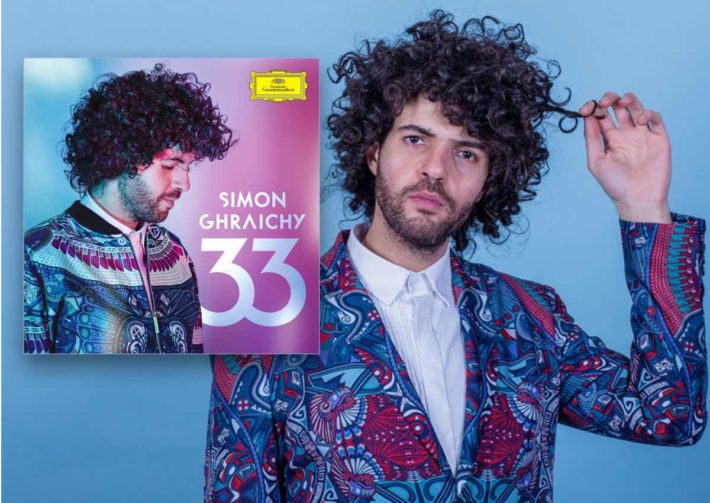
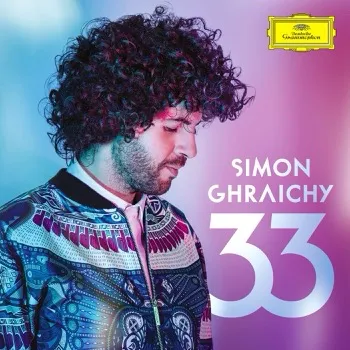
The first thing that strikes you about this album is the colorful sound Simon Ghraichy brings out from the instrument. This is also due to the unique timbre of the piano and the relatively close recording. The album starts with a lovely transcription by the pianist, followed by uniquely programmed set of pieces and composers, the center of which is Schumann’s “Humoreske” and “Etudes In Variation Form on a Theme By Beethoven” (based on the second movement of the Seventh Symphony).
Schumann also stands in the center of the album conceptually, with pieces such as Chilly Gonzales’ “Robert on the bridge”, a commissioned piece, with Gonzales joining in. Other connections emerge, such as the latin-sounding “Passionato” movement in the variations, resembling the short Ramirez transcription heard earlier (track 3) or the almost circular opening of the Humoreske, echoed later in the minimalist music of Philip Glass and Michael Nyman.
A fascinating program, then, projecting new ideas on relatively known repertoire. But taken alone, the Schumann pieces are nicely done indeed. The Humoreske sounds incredibly modern in this context, more heavily textured than other digital recordings by András Schiff or Radu Lupu. Ghraichy brings out some hidden voices in the second, “Hastig” movement, preparing the main event coming in at 1:50 quite impressively. Or the left hand figurations brought out with multicoloured overtones in the third movement (track 6). This is “out of the box” pianism, which will make many veteran listeners want Ghraichy to “clean the pedal”, missing out on the effect. He does know when to lift his right foot, though, as shown in the quicker, more lightly textured moments of this piece.
Baboni Schilingi’s “Huge”, a combination of acoustic and electronic music, is another attention grabber, perhaps influenced by what the program overview, explaining the concept of this album, refers to as “the inner voice” in the Humoreske, where “(…) the composer has inserted between two staves some measures that only the pianist can read and hear”. It’s another example of how effectively contrasted the Schumann-Beethoven variations sound when coming in next on this album.
Speaking of this concept, the album is said to be dealing with the pianist’s ”(…) anxieties, his madness and his fascination for time”, a concept which will, perhaps, be more readily clarified with the physical album and included printed material. For streaming listeners it will be no less enjoyable for the musical qualities alone. Together with albums such as Jeremy Denk’s “Circa” reviewed here and Igor Levit’s “Life”, pianists show more and more creative courage of bringing out highly original yet engaging and enjoyable programs. This is one of those. Recommended.

The Classic Review Newsletter
Get weekly updates about new classical music content.
By signing up, you acknowledge and agree to our Privacy Policy & Terms of Service .
“33” – Works by Schumann, Chilly Gonzales, Philip Glass, Michael Nyman, Baboni Schilingi, Szymanski, Tárrega, Alkan, Ramirez
Simon Ghraichy – Piano
Deutsche Grammophon, CD 28948177332