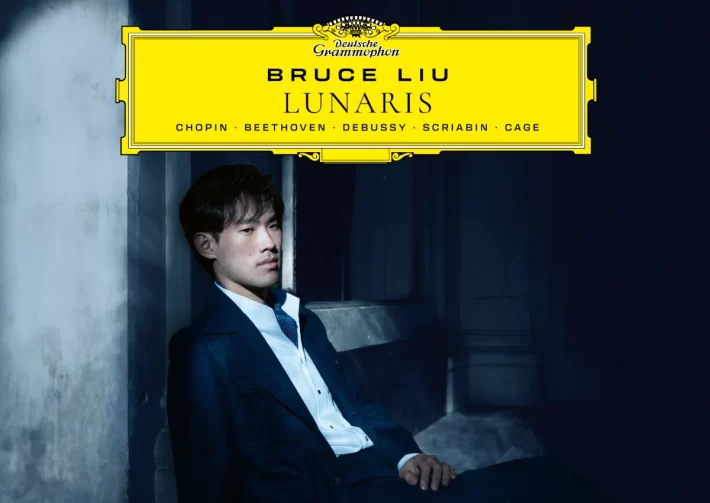
In his booklet interview with Michelle Assay for Lunaris, Bruce Liu discusses his fascination with the night and his inner world of sound. The program includes familiar works like Beethoven’s Moonlight Sonata alongside pieces by Mompou, Cage, and Agnes Obel.
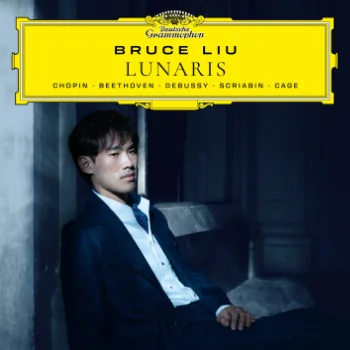
Liu notes that Beethoven’s Moonlight Sonata anchors the curation. A major point of interest is Beethoven’s marking that the entire first movement be played without dampers (senza sordini). On a modern piano, this implies holding the damper pedal down continuously, an approach that can be problematic given the instrument’s resonance compared to a fortepiano. Liu’s pedaling remains clean throughout. While the Adagio sostenuto (track 2) leans toward the austere, it communicates the intended solemnity.
The Allegretto is deliberate without becoming mannered in its elegance, while the Presto agitato (track 4) introduces the necessary intensity. Liu’s precise fingerwork prevents the textures from becoming oversaturated, and the subito accents drive the volatility and urgency central to the movement.
Beethoven’s Sonata Op. 53 (Waldstein) serves as a thoughtful pairing with the Moonlight. The opening movement (track 8) captures the con brio spirit with tight articulation and clarity, and Liu’s decision to highlight select secondary voices adds dimension to the reading. The Introduzione (track 9) is calm, yet Liu uses moments of inflection toward its close to generate the suspense needed to connect to the final movement. The finale reflects the sonata’s L’Aurore nickname: Liu’s pedaling imparts the haze of dawn upon the opening theme (where Beethoven again asks for the pedal to be held). As the music reaches its climax, the textures become drier, resulting in an unusually crisp presentation.
Scriabin’s Sonata No. 4 in F-sharp major (tracks 16-17) presents two distinct shades of anticipation. In the Andante, Liu demonstrates sensitivity and imagination, projecting a different tonal shade for each shifting harmony. This quiet yearning builds tension that is released in the Prestissimo volando. He navigates the rapid passages with precision and a certain lightness, the larger sections stay controlled without feeling subdued, and the movement’s trajectory of intensity is clearly shaped.
While Debussy’s Clair de lune might seem an expected inclusion given the program’s theme, Liu opts instead for the composer’s Rêverie (track 5). From the hypnotic ostinato that opens the work, he builds a multicolored reading that alternates between lush and enigmatic textures. Across this range of expression, Liu’s bell-like tone maintains structural cohesion.
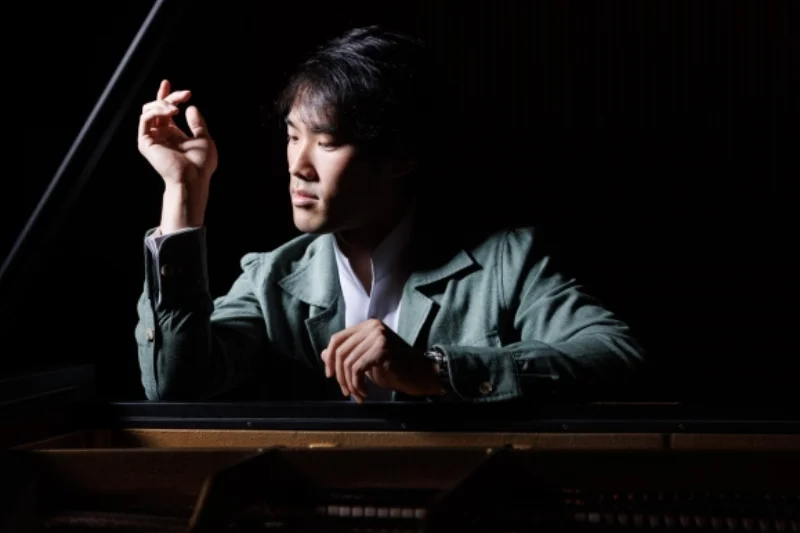
Bruce Liu. Photo © Bartek Barczyk.
Agnes Obel’s Tokka (track 7) is a meaningful addition in both genre and artistry. Through the music’s relative sparseness and concise phrases, Liu conveys transience and fragility. Similarly concise in phrasing, the first of Arnold Schoenberg’s 6 Kleine Klavierstücke, Op. 19 (track 14) offers an alternative perspective: Liu highlights the work’s angularity through a hushed tone, sharp articulation, and a persistent sense of enigma. Note that the Schoenberg, along with Reynaldo Hahn’s Hivernale, appears only on the digital and vinyl editions of the album; the CD omits both tracks.
Liu takes a notable approach to the final work, John Cage’s Dream. Across the thrice-repeated material, he uses three different keyboards between two pianos (noting in the booklet that one instrument features two keyboards), and the effect is perceptible: each iteration has a distinct character, with the second sounding appropriately distant and murky. Throughout, Liu’s playing combines reflection, declamation, and meditation, emphasizing the structure of Cage’s minimalism.
In a concept album of this nature, hearing directly from the artist is valuable. The detailed interview with Assay serves as an important companion to the program, presenting Liu as an introspective and articulate musician. His commentary aligns with performances that are insightful and reward a dedicated listen.
Recommended Comparisons
Beethoven: “Moonlight” & “Waldstein” Sonatas
Wilhelm Kempff | Radu Lupu | Vladimir Horowitz | Pavel Kolesnikov