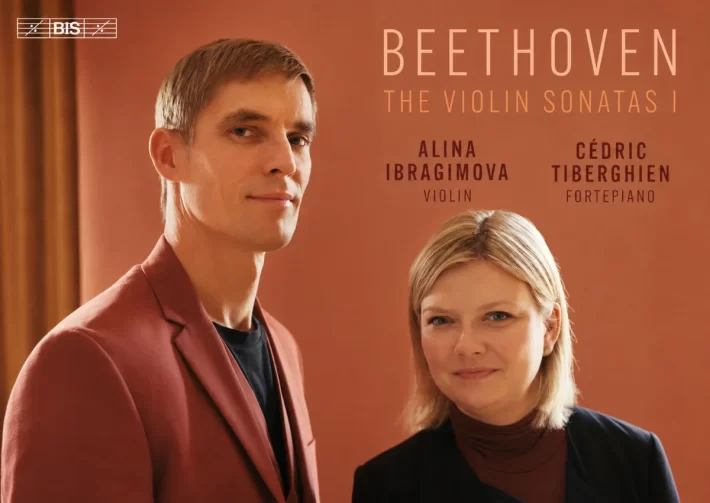
Alina Ibragimova and Cédric Tiberghien have returned to Beethoven‘s violin sonatas, this time performing exclusively on period instruments. Having previously recorded the complete cycle on modern instruments for the Wigmore Hall Live label, the duo opens this new project with the three Op. 12 sonatas and the Spring Sonata (No. 5). Ibragimova plays a c. 1775 Anselmo Bellosio violin, while Tiberghien performs on a Paul McNulty fortepiano modeled after a 1794 Anton Walter instrument. Walter was a premier maker whose fortepianos were favored by both Mozart and Beethoven, making this an ideal historical match for the repertoire.
In the Violin Sonata No. 1 in D Major, Op. 12 No. 1, the duo immediately establishes a standard of precision. The Allegro con brio is immaculate in its synchronicity and articulation, from the neatly truncated phrasing of the opening bars to the clarity of the rolling arpeggios. Despite this exacting attention to detail, the quintessential Beethovenian spirit of contrast and surprise remains fully intact; the musicians grasp the raw vitality of one moment and juxtapose it with grace and lyricism in the next. While the period instruments may not possess the powerful, rounded polish of their modern counterparts, their rawness imparts a distinct and memorable flavor. The slightly rough-around-the-edges timbre and scrappy enthusiasm only heighten the sense of authenticity in the performance.
The middle movement, a theme and variations, is arguably the most emotionally eclectic section of the sonata, and the duo wastes no time exploring the character of each variation. The theme evokes the charm of a Mozart minuet, giving way to a graceful dialogue between violin and piano in the subsequent variations. As the music gathers momentum, the violin assumes an increasingly pleading tone that heightens the tension. The minor variation at the 3’48” mark is where true Beethovenian drama makes its entrance. Tiberghien and Ibragimova wholeheartedly embrace the stormy intensity, with the fortepiano providing a convincing rumble in its bass register.
Of the other two sonatas in the Op. 12 set, No. 3 in E-flat Major calls to mind the Eroica symphony, not just due to the shared key, but also in its regal character. Here, the duo taps into another dimension of their artistry: the ability to create a convincing orchestral profile. The Allegro con spirito presents a noble and stately personality, while the Rondo adds a more assertive, rhythmic drive. The relative lightness of the period instruments in no way inhibits the players from generating a resplendent, full-bodied tone.
The Sonata No. 2 in A Major follows and serves as the most playful, yet virtuosic, offering on the program. In the Allegro vivace, the duo brings humor and persistence to the inquisitive two-note phrases, but it is the meticulous, effortless-sounding passagework that truly stands out. This whimsical energy establishes a striking contrast with the middle movement, the only one on the album set in a minor key. Tiberghien and Ibragimova seize this rare moment of melancholy to deliver a tender, sensitive reading of real gravity.
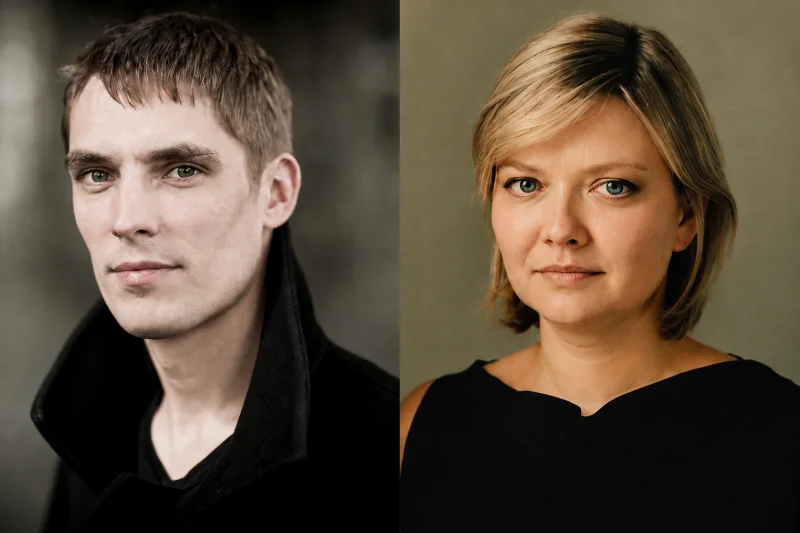
Cédric Tiberghien and Alina Ibragimova.
For the Spring Sonata, the duo makes the most of the qualities of their period instruments to present a zesty, energized interpretation. A side-by-side comparison with their previous modern-instrument recording reveals pointed differences. While certain interpretive mannerisms remain — such as Tiberghien’s rubato in the piano part or Ibragimova’s crisp bowing and tight rhythms — the modern version feels warmer, mellower, and heavier, largely due to the modern piano’s resonance. Conversely, the period recording feels perfectly fitted to the idyllic, refreshing spirit of the sonata.
Throughout the Allegro assai, Tiberghien displays fine control over phrase contouring. The tone of a fortepiano can often feel fleeting, yet he manages to create grounded, distinct closures to his phrases, alongside finely graded softer dynamics. Ibragimova matches this level of musicianship, offering a wide range of timbral characters. Her violin can drop to barely a whisper, yet quickly pivot to a much more adamant profile during robust passages. A minor gripe is that the violin occasionally overpowers the piano, though this may be more a matter of microphone placement than musical balance.
The slow movement provides a glimpse into the opposite end of the emotional spectrum, replacing bubbling energy with a deeply satisfying calm. Once again, the period instruments lend an added angle of translucence and fragility rarely heard on modern recordings. The duo is superbly matched here, with Ibragimova providing a supportive, sensitive backdrop during the piano’s melodic lines.
Richard Wigmore’s accompanying liner notes offer helpful stylistic analysis and commentary on the sonatas’ connections to other works in Beethoven’s catalogue. Ultimately, Tiberghien and Ibragimova prove fully at home in the period-instrument domain, delivering performances of real dimension and personality. Should you buy this album if you already own the previous cycle by the duo? The answer is yes, and certainly if you are looking for what promises to be a first-class period-instrument cycle of Beethoven’s complete violin sonatas.
Recommended Comparisons
Beethoven: Violin Sonatas
Ibragimova & Tiberghien (2010) | Mullova & Beatson | Kurosaki & Nicholson | Faust & Melnikov