
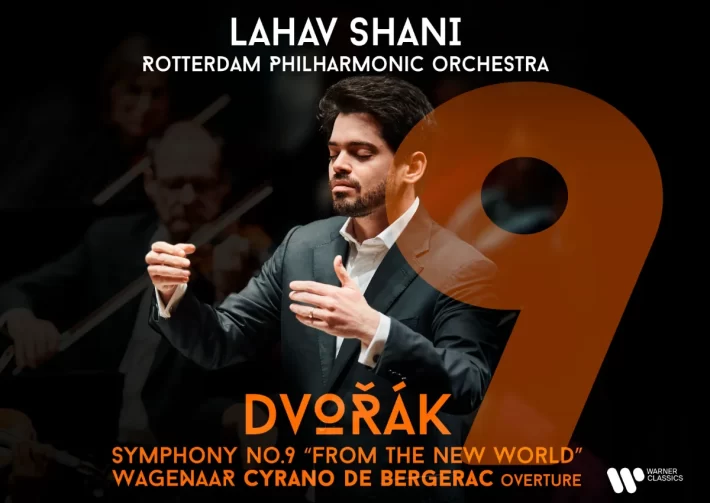
This new recording opens with a rarity, Johan Wagenaar’s Cyrano de Bergerac Overture. Wagenaar was an important teacher and composer in Utrecht, but by the 1920s his late-Romantic style was considered outdated, and his music received scant attention outside the Netherlands. The overture’s soaring melodies, opulent harmonies, and bold orchestration show the influence of both Berlioz and Strauss, though I would argue that Wagenaar has his own distinct voice.
Shani leads an exciting reading, with carefully balanced textures that let us appreciate the music’s contrapuntal complexity. He shapes the music well and encourages some resplendent brass at climaxes. Two other excellent performances both feature the Royal Concertgebouw Orchestra: Mengelberg in 1942, available on YouTube, and Chailly (1990/Decca). Neither is easy to find on CD today (though both can be streamed at Presto or Amazon), so Shani’s performance has the field to itself.
Presto lists over 400 recordings of Dvořák’s final symphony; in an overly crowded field, a new recording should offer something that challenges or exceeds what is already available. In recent years I reviewed performances by the Czech Philharmonic (Bychkov/Pentatone – review) and the Atlanta Symphony Orchestra (Stutzmann/Erato – review). Bychkov’s reading is beautifully played and recorded, but emotional engagement comes and goes. The Atlanta orchestra does not match the sophisticated sheen of their Czech counterparts, but Stutzmann’s emotional connection is complete, and she takes interpretive risks that, even after repeated hearings, never strike me as mannered or willful. I find her reading exciting, spontaneous, and compelling.
This performance shows the Rotterdam orchestra in top form. The conducting and engineering ensure a transparency that reveals the inner workings of Dvořák’s score. Shani honors the score’s markings and leads with an excellent sense of structure. Nothing in this interpretation feels mannered or willful. Yet, despite these positive qualities, Shani’s reading does not really stand out from other similarly well-executed recordings.
Lack of forward drive is a significant issue. For instance, in the opening movement’s transition from Adagio to Allegro molto (circa 0’55”), brass and timpani speak resoundingly. But the articulation needs the cut and thrust heard in readings by Rafael Kubelík (Berlin PO/DG), Andris Nelsons (Bavarian RSO/BR Klassik), and Charles Mackerras (Prague SO/Supraphon). Each of these imparts a greater sense of anticipation and urgency. The same issue afflicts the remainder of the movement. The molto indication is not really honored: the performance focuses instead on balance and beauty of sound at the expense of momentum. Kubelík, Nelsons, and Mackerras are also balanced and beautiful, but they have a drive and excitement that is lacking in Shani’s reading.
The second movement (13’13”) is quite slow. By comparison, Bychkov takes 11’12” (a particularly beautiful rendition, especially the English horn); Mackerras, 12’21”; and Giulini (Philharmonia/Warner Classics), 12’33”. All of these readings are sweetly sung, but there is greater passion in the older readings. Kubelík is almost as slow as Shani, but the Rotterdam orchestra cannot match the finesse and richness of the Berliners.
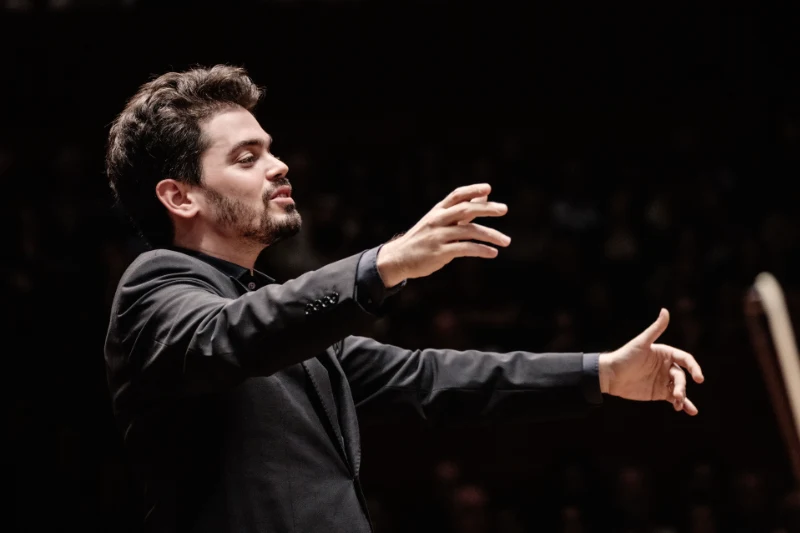
Lahav Shani. Photo © Marco Borggreve.
I find the Scherzo far more successful: here is the energy and joie de vivre I missed in the opening movement. The Trio has a delightful lilt and range of colors. Yet turn to both Nelsons and Stutzmann, and one can hear more turbulent passions than are heard here.
Similar issues affect the final movement. The problem is not one of tempo: Shani’s timing of 11’40” is only two seconds shorter than Dudamel’s recent Los Angeles performance (DG, a digital-only recording of the final three symphonies that has not had the recognition it deserves). The playing is undeniably excellent, and there is greater furor. But turn to Dudamel, or the other recordings mentioned above, to hear readings with an inexorable flow missing from the present performance. The lack of momentum affects the emotional power of this reading: with Shani, the passage around 1’55” feels gentle and pretty. Under Nelsons and Dudamel, the tempo change (and shift in mood) is more potent. Wind solos, both here and throughout the symphony, are beautifully played, but they lack the individual flair of their colleagues in Berlin, Los Angeles, and Prague.
I admire the freshness and lack of mannerisms: Shani never strives to make interpretive points that go against the score. But I want more vigor and more unbridled excitement in a performance of this symphony. Despite the excellence of the playing, if I had to choose between this ‘moderate’ interpretation and the similarly conceived Bychkov/Czech Philharmonic recording, I would choose the latter. Readers who prefer a more relaxed approach may find more to admire and enjoy than I did.
Recommended Comparisons
Dvořák: Symphony No. 9
Rafael Kubelík | Charles Mackerras | Semyon Bychkov | Nathalie Stutzmann
Album Details |
|
|---|---|
| Album name | Dvořák: Symphony No. 9 ‘From the New World’ |
| Label | Warner Classics |
| Catalogue No. | 2685431458 |
| Artists | Rotterdam Philharmonic Orchestra, Lahav Shani (conductor) |



DIE DIENSTAG-PRESSE, 9. JUNI 2026 - Klassik begeistert
[…] Recordings Review: Dvořák – Symphony No. 9 (‘From the New World’) – Rotterdam Philharmonic, Lahav Shani TheClassic.review.album.dvorak […]