Brahms composed the Double Concerto for violin, cello and orchestra late in his career, pairing the two instruments in a work that stands apart from his other orchestral scores. Written in 1887 for Joseph Joachim and Robert Hausmann, it blends symphonic breadth with an unusually conversational form, the two soloists engaging more as chamber partners than as virtuosi set against the orchestra. Across its three movements it moves from a turbulent, densely argued opening through a lyrical Andante to a driven finale that brings a more athletic, energetic character.
Here are The Classic Review editorial team’s recommendations for the best recordings of Brahms’s Double Concerto.
Oistrakh, Rostropovich, Szell
This 1969 recording has been a first recommendation for the Double Concerto almost since it appeared. David Oistrakh and Mstislav Rostropovich were at the peak of their careers, and George Szell drew chamber-music precision from the Cleveland Orchestra.
Oistrakh’s tone is warm and full, intense yet always poised, and Rostropovich answers with a broad, sonorous line of comparable weight. Neither soloist forces the sound, even at the music’s biggest climaxes. Szell keeps the orchestral texture clear, so the inner parts and woodwind detail register beneath them. Decades later, it remains the recording most others are measured against.

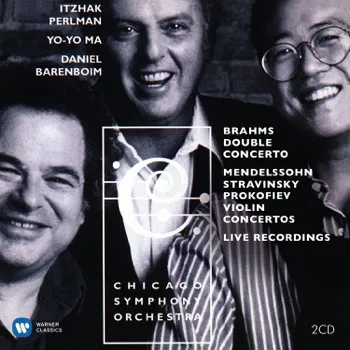
Perlman, Ma, Barenboim
Recorded in Chicago in 1996, this is a vivid, quick-witted account of the Double Concerto. Itzhak Perlman and Yo-Yo Ma had known the music, and each other, for years, and they trade its lines with flair and split-second response.
Daniel Barenboim and the Chicago Symphony play brilliantly behind them, giving the performance vigor and a real Romantic sweep. Perlman’s tone is full and gleaming, Ma’s rich and responsive, and their exchanges crackle with energy and joy. The disc couples the concerto with Perlman’s account of the Mendelssohn Violin Concerto, an attractive pairing for admirers of either player. For the sheer vitality of two great soloists at their peak, it is hard to beat.
Shaham, Wang, Abbado
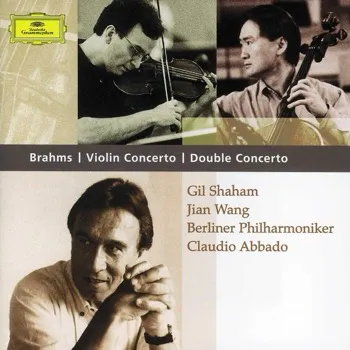
Claudio Abbado and the Berlin Philharmonic made this recording in 2001, and it has all the rich, idiomatic Brahms sound that distinguished their work together. Within that warm orchestral setting, Gil Shaham and Jian Wang take the two solo parts.
Shaham’s violin has the bright, gleaming tone that has always marked his playing, and Wang partners him on the cello. Abbado surrounds them with the warm strings, mellow winds and firm bass lines that give this performance its glow, never hurrying the music or letting its long lines sag. The result is lyrical and full-bodied rather than lean, recognizably the work of the same musicians who recorded the symphonies. The disc also includes the Brahms Violin Concerto, again with Shaham as soloist. Anyone who loves Abbado’s Brahms cycle with the Berlin Philharmonic will want this Double Concerto beside it.
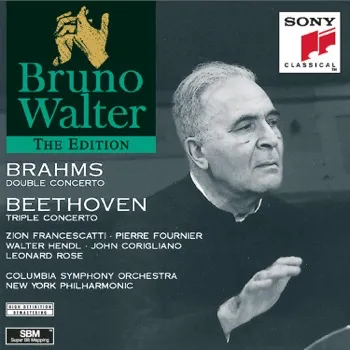
Francescatti, Fournier, Walter
Zino Francescatti and Pierre Fournier are beautifully matched in this 1959 recording, both playing with elegance and a certain reserve. Bruno Walter, in his final years, conducts in a broad, mellow style that draws out the work’s lyrical warmth.
The smaller orchestra he used gives the accompaniment a lean, uncluttered sound, lighter than the full symphonic weight other conductors bring to it. Francescatti’s violin is refined and gentle, Fournier’s cello smooth and even. Some will find the reading too relaxed, and the finale could use more bite. It dates from the same late-1950s sessions as Walter’s stereo Brahms symphony cycle with this orchestra, and belongs unmistakably with it. Caught in good early stereo, with two soloists who genuinely sound like allies, it remains a notably genial account of the work.
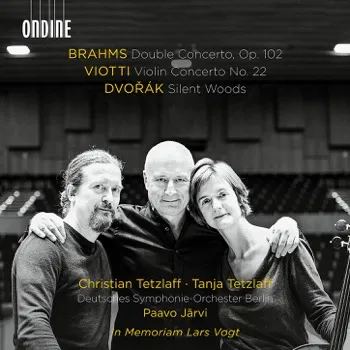
Tetzlaff, Tetzlaff, Järvi
The closeness of Christian and Tanja Tetzlaff is the whole point of their 2023 recording. Brother and sister have played chamber music together for decades, and in this most conversational of concertos they pass the music between them as though it were a single line of thought.
Paavo Järvi and the Deutsches Symphonie-Orchester Berlin give the two soloists a full, well-balanced setting, always alert to their every move. The slow movement is the high point, its rubato free and songful, closer to speech than to declamation. The finale brings out the music’s Hungarian color, the two players dovetailing their phrases at speed. On the same disc are Viotti’s Violin Concerto No. 22, a work Brahms loved and quoted in this very score, and Dvořák’s Silent Woods.
Top image ©️ The Classic Review, AI generated

The Classic Review Newsletter
Get weekly updates about new classical music content.
By signing up, you acknowledge and agree to our Privacy Policy & Terms of Service .