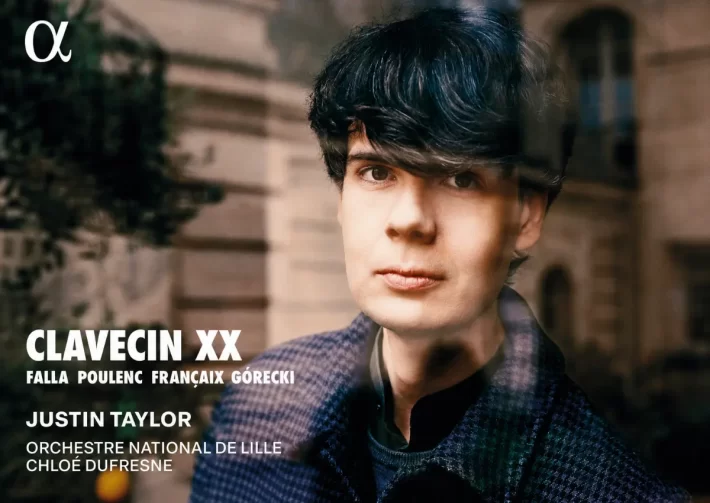
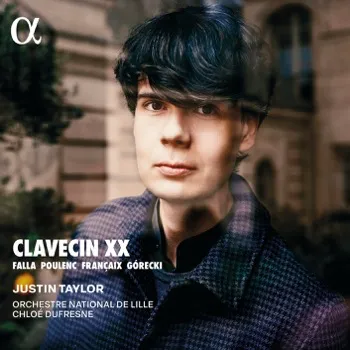
Justin Taylor’s Clavecin XX presents an intriguing selection of solo and ensemble works by Bartók, Françaix, Górecki, Poulenc, and Manuel de Falla, placing a traditionally antiquated instrument squarely in a modern context. For this recording, Taylor utilizes a 1970s harpsichord by Anthony Sidey that hybridizes elements from 1920s Pleyels with much earlier models. This versatility, the artist notes, allowed him to rely on a single instrument throughout the diverse recital. Indeed, the Sidey instrument’s profile encompasses an array of personalities and sonorities that are brilliantly unveiled across the album.
Referencing Baroque forms like the Toccata and Minuet, Jean Françaix’s Concerto features a distinctive tonal language that places the harpsichord in a curious perspective. Deriving its energy from Taylor’s full-bodied tremolos, Toccata I is further animated by piquant string pizzicatos that add a sprightly, balletic quality.
Sharing a similar texture but adopting a diametrically opposed, lyrical profile, Toccata II allows the keyboardist to trace horizontal lines with a pleasing legato, its fluidity highlighting refreshing harmonic progressions.
Demonstrating the chameleon-like quality of the instrument, Taylor shines in the Minuet. Here, the harpsichord occasionally resembles a dulcimer or a Japanese koto, bringing a fitting dimension to a multifaceted compositional language steeped in Impressionism, cinema, and dance.
Serving as a stark departure from the preceding charm, the selection by Henryk Górecki is deeply stimulating in how its two movements employ repetitional minimalism to cast the harpsichord in strikingly different lights. Taylor’s even-keeled perpetuum mobile in the Allegro molto is insistent, clashing unapologetically with the equally stubborn, static ensemble part. The resulting sonority is mechanical, bordering on the computerized.
Driven by relentless chords, the subsequent Vivace marcatissimo builds profound tension. The performers do a remarkable job maintaining metronomic precision, molding a conflict that eventually comes to a head as spectacular harmonic collisions evolve into a frenetic sonic assault—an effect most certainly intended given the music’s inherent angst.
While Manuel de Falla’s selection injects rhythmic vitality into the program, Francis Poulenc‘s Concert champêtre stands out for its high-spirited, imaginative execution. Written for Wanda Landowska (an artist Taylor cites as a major inspiration), the concerto operates in a Neo-Baroque style. Conjuring stately authority in their slow introduction, the orchestra sets the stage for the keyboardist to bring elegant liveliness to the Allegro section.
The Finale is arguably the most engaging movement due to its sheer eclecticism. Launching as a virtuosic Gigue, it quickly diversifies to encompass hints of improvisation, a march, and elements drawn from Romantic and Neo-Romantic symphonies. Adapting to this complex structure admirably, the performers ensure no particular reference feels contrived or out of place. In this work, as in the other concertos, the Orchestre National de Lille under Chloé Dufresne is an attentive partner, articulating the clever counterpoint clearly while never overshadowing the harpsichord.
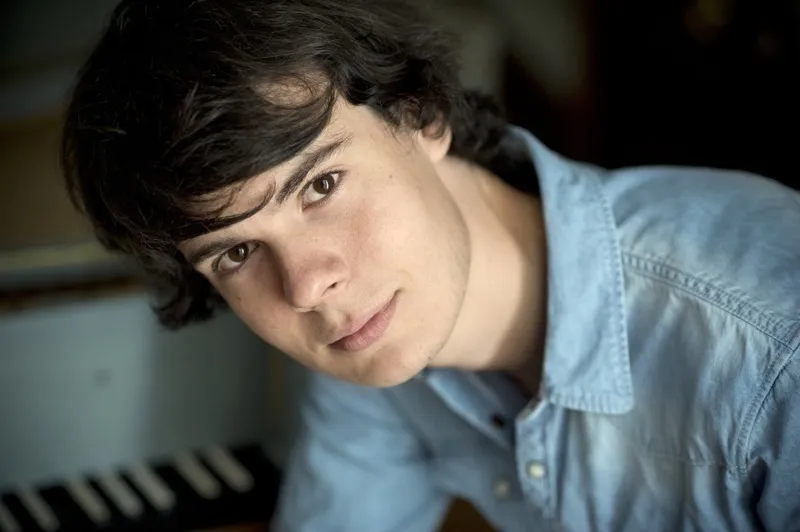
Justin Taylor. Photo © Jean-Baptiste Millot.
Turning to the solo works, the opening selection from Bartók‘s Mikrokosmos serves as a brief but wonderfully rendered introduction, establishing the character of the entire program through its interplay between consonance and dissonance. Taylor’s precise articulation gives the notes ample space to resonate, allowing listeners to appreciate them individually while sympathetic resonances beautifully mingle.
Paying homage to György Ligeti’s landmark harpsichord work Continuum (which famously transforms the instrument into an ominous, persistent buzz), Stéphane Gassot’s Bluesinuum offers a gentler take. Although it references a similar trill-like texture in its middle section, Gassot’s approach is notably more subdued. Taylor’s bluesy rhythms possess both snap and fluidity, while occasional lower-register rumbles introduce a welcome playfulness to the mix.
Concluding the album is a familiar tune: Scott Joplin’s Maple Leaf Rag. While the execution is solid and the artist’s transcription remains faithful to the original, hearing this piece on a harpsichord proves difficult to digest. The timbre of the instrument simply does not suit the repertoire, transforming the music’s inherent jauntiness into something rather heavy and labored. Perhaps this iconic rag is best left to its intended medium, the piano.
Taylor’s interview in the liner notes portrays him as a well-spoken, meticulous musician who has invested significant research into his repertoire prior to performance. With the exception of the final track, this curation stands as an engaging testament to the harpsichord’s vast capabilities well beyond its traditional Baroque boundaries. Though not all the pieces make for easy listening, Taylor undeniably maximizes the instrument’s technical and musical capacity.
Album Details |
|
|---|---|
| Album name | Clavecin XX |
| Label | Alpha Classics |
| Catalogue No. | ALPHA 1041 |
| Artists | Justin Taylor (harpsichord), Orchestre National de Lille, Chloé Dufresne (conductor) |