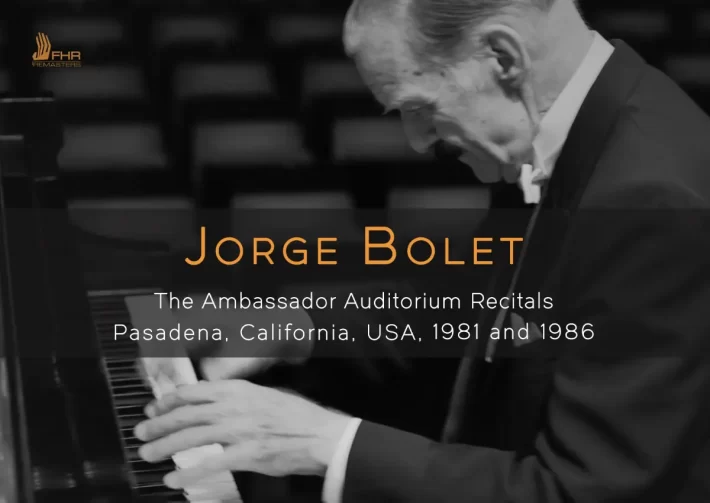
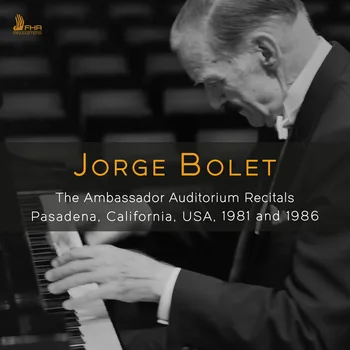
This three-CD box set is something of a rarity, given that many of Jorge Bolet‘s live performances recorded professionally have not been released commercially. The two Ambassador Auditorium recitals (1981 and 1986) are from the last decade of an illustrious career. Originally intended as archival recordings, they have been restored and remastered to give us a chance to hear Bolet in the space he preferred — the stage.
Schumann’s Op. 17 Fantasy is one of the major works in the November 11, 1981 performance. Compared to more contemplative recordings (Richter and Perahia come to mind), this version leans toward extroversion, an interesting dynamic to bring to a work that is introspective at its core. The opening lines of the first movement (CD 1, track 4) feature emphatic dotted rhythms and chords that feel a bit punchy. Taken in the larger context of the movement’s yearning, however, Bolet’s interpretation makes total sense. He captures the passionate spirit and communicates its rawness. At the same time, he connects with the audience on a deeper level in quieter moments, like the hymn-like material at 5’00”.
Bolet’s joyous energy in the middle movement is enough to uplift the most discerning listener, wrong notes and all, but the most convincing movement is the Langsam (CD 1, track 6). The pace is more measured than Pollini or Argerich, yet perfectly suits the transcendent nature of the writing. While Pollini’s version is memorable for its tonal beauty, Bolet’s stands out for the flexibility he brings to the phrasing; the small pauses at choice moments add to the expressivity of the lines.
The 1981 concert features a selection of Schubert-Liszt song transcriptions, of which Der Müller und der Bach (CD 1, track 8) stands out as a study in nuance. Beyond the impeccable voice leading, the melody takes on a distinctly vocal quality, the pianist showing a clear understanding of how the voice inflects and moves and, most importantly, expresses grief and loss. The famous Erlkönig (CD 1, track 11) is a completely different take from the benchmark live recording of Evgeny Kissin’s 1990 Carnegie Hall debut. Where Kissin fuels the drama and terror through speedy, aggressive octaves, Bolet establishes a more austere presence. His reading of the character of Death speaks to inevitability rather than urgency, yet is no less frightening.
A Unified Theme of Ballades
The repertoire of the 1986 recital is thoughtfully curated: Grieg’s Op. 24 Ballade, Brahms’s Op. 10 Ballades, and Liszt’s S. 171 Ballade are works that have received less exposure, complementing Chopin‘s more famous cycle. In the Grieg, Bolet captures the tonal ambiguity that seems to set up the eclectic, unpredictable spirit of the whole work. Lyricism, whimsy, and cataclysm are all rendered with conviction, yet Bolet ties them together with a unified sense of sadness.
While Brahms’s early Op. 10 set lacks the profundity of the late Op. 116–119, the seeds of that language are already present. In No. 1, Bolet evokes the tension between subtlety and storminess through rapid surges from soft to loud, lending persistence to the recurring four-note motif. No. 2 offers a similarly effective juxtaposition of opposites, though at times the loud passages come off too strident. No. 3 has the most striking personality, its off-kilter melodic material giving Bolet room to build an inviting unpredictability. For all its raging fury, the latter part of the Intermezzo reveals some of his most tender playing of the program.
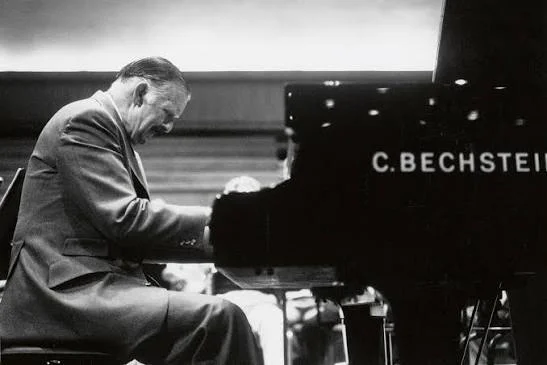
Jorge Bolet, Paris, 1988. Photo © Wilhelm Fröling.
As the centerpiece of the 1986 recital, the four Chopin Ballades (CD 3, tracks 2–5) don’t disappoint. The most striking aspect throughout is Bolet’s game of opposites. In the F major Ballade, grace and fury interplay dramatically; the minor sections are especially memorable as they edge on a recklessness that rarely surfaces in his normally deliberate style. As the most difficult and perhaps most emotionally complex of the set, the final Op. 52 is beautifully rendered and shows years of familiarity with the work. The F minor sections, despite their melancholy, reveal his sensitivity to Chopin’s shifts in harmonic color, and the lithe melodic lines capture the essence of bel canto. The Coda is one of the most electric moments of the recital.
Given that the concerts were originally recorded on open-reel tapes, the 24-bit/96 kHz transfer and remastering by Kabir Hermon and John Croft is impressive. The fidelity of Bolet’s playing comes across cleanly, as does the character of the instrument. Hearing archival recordings with this much clarity is a rare pleasure, especially from a legend of the twentieth century.