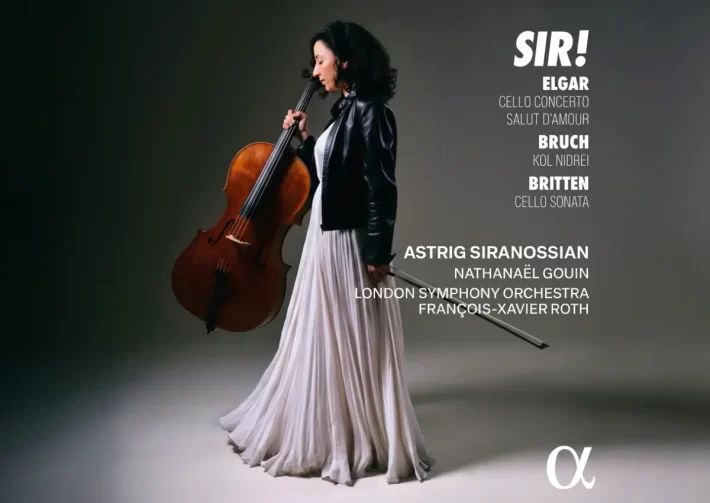
This is French cellist Astrig Siranossian’s fifth release on the Alpha label, and her earlier albums cover a wide-ranging repertoire in which she appears both as a chamber musician and as a soloist. Here she is joined by the London Symphony Orchestra and François-Xavier Roth for Elgar’s Cello Concerto, with Britten’s Cello Sonata, Bruch’s Kol Nidrei and Elgar’s Salut d’amour completing the program.
There are some ninety readily available recordings of the Elgar Cello Concerto, so Siranossian is entering a crowded field. Every new release is measured against Jacqueline du Pré’s legendary performance with Barbirolli and the LSO (Warner Classics), and that status is well earned — I know of few other concerto recordings in which the solo part is played with such overwhelmingly personal, emotional expression. Barbirolli’s accompaniment is just as involving. But it is fascinating to hear Elgar’s own 1928 recording with Beatrice Harrison (the composer conducting the New Symphony Orchestra, Warner Classics), where his less heart-on-sleeve leadership has a different but potent emotional effect.
Recent performances tend to fall into two contrasting interpretive camps. Some are gentler and more emotionally restrained, such as Paul Watkins/BBC Philharmonic/Davis (Chandos), Gautier Capuçon/LSO/Pappano (Erato), and Daniel Müller-Schott/Oslo Philharmonic/Previn (Orfeo). Others embrace a more extroverted emotional approach like du Pré’s that is nevertheless their own, such as Pieter Wispelwey/Netherlands Radio Philharmonic/van Steen (Channel Classics), Steven Isserlis/Philharmonia/Paavo Järvi (Hyperion), and Johannes Moser/Suisse Romande/Manze (Pentatone). Siranossian’s interpretation falls into the latter category.
Her playing, caught up close by Alpha’s engineers, draws a dazzling range of colors from the 1756 Gennaro Gagliano cello. Siranossian’s interpretive ideal is signaled in the opening recitative: marked fortissimo and nobilmente, the initial attack is ferocious and emotionally raw, the nobilmente honored through color and weight rather than any stiff-upper-lip reticence. Her first statement of the main theme is silvery and lithe, while the later restatement is full-toned and impassioned.
The second movement (Lento – Allegro molto) brings a delicate, playful lightening of mood, answered by an Adagio of greater intensity, the playing more inward and contemplative, the cello’s color at times blanched and exhausted. The final movement returns to a more unreserved, impassioned manner, surveying darker regions of the score that others leave unexplored. The LSO, which has played this score more times than anyone can count, strives to match Siranossian’s intensity, but is sometimes hampered by Roth’s more objective leadership. There is compensation in hearing the score laid out with such transparency, allowing us to appreciate the craft of Elgar’s writing.
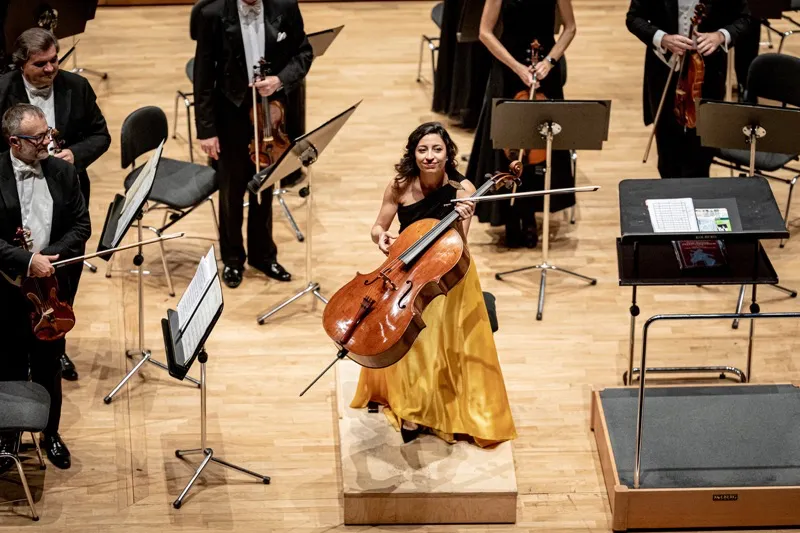
Astrig Siranossian.
I last wrote about Britten‘s Cello Sonata in a review of Sheku Kanneh-Mason’s 2025 Decca recording. That reading, like this one from Siranossian and pianist Nathanaël Gouin, a regular duo partner, leans into the tough modernity of Britten’s writing. If the Kanneh-Mason siblings find more playfulness in the second-movement Scherzo, Siranossian and Gouin more thoroughly uncover the darker musings of the third-movement Elegia, albeit at a significantly faster tempo. The Marcia lacks the menace Johannes Moser finds (with pianist Paul Rivinius, Hänssler), but the closing Moto perpetuo has ferocious momentum and drive, without eclipsing the unique energy and bravado of Rostropovich’s account with the composer (Decca).
Bruch‘s Kol Nidrei is built around two Jewish melodies. The composer described the first as “an age-old Hebrew song of atonement”; the second, in D major, draws on “O weep for those that wept on Babel’s stream,” a song he called moving and truly magnificent. The only performance of the work I own is János Starker’s with the LSO led by Doráti (Eloquence). It is quite lovely, both pained and calming. Siranossian’s slightly slower reading is more sweetly voiced and more openly poignant. Elgar’s Salut d’amour makes a perfect digestif.
Alpha’s engineering is excellent, and it is particularly good to hear the LSO away from the acoustically challenged Barbican Hall; the concerto sessions took place at LSO St Luke’s. The liner notes consist of a January 2026 interview in which Siranossian spends more time on what connects her cello (once owned by John Barbirolli) with the repertoire on the album than on the music itself. Nevertheless, after hearing this recording I intend to hear Siranossian’s earlier albums — recommended.
Recommended Comparisons
Elgar: Cello Concerto
Jacqueline du Pré | Steven Isserlis | Paul Watkins | Gautier Capuçon
Britten: Cello Sonata
Rostropovich & Britten | Sheku & Isata Kanneh-Mason | Moser & Rivinius | Gerhardt & Osborne
Bruch: Kol Nidrei
János Starker | Jacqueline du Pré | Pierre Fournier | Matt Haimovitz
Album Details |
|
|---|---|
| Album name | Sir! – Elgar: Cello Concerto, Salut d’amour; Bruch: Kol Nidrei; Britten: Cello Sonata |
| Label | Alpha Classics |
| Catalogue No. | Alpha 1217 |
| Artists | Astrig Siranossian (cello), Nathanaël Gouin (piano), London Symphony Orchestra, François-Xavier Roth (conductor) |