
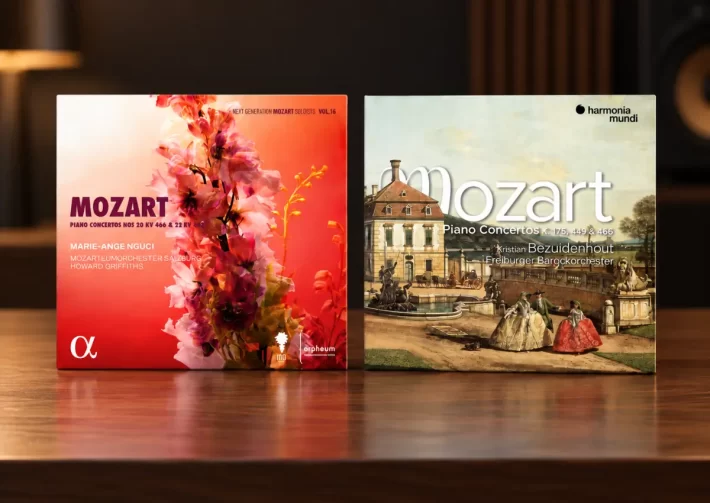
Alpha’s release is the latest in its Next Generation Mozart Soloists series. In recent years, pianist Marie-Ange Nguci has gained a reputation for concerto performances in which she leads from the piano, but here she partners with conductor Howard Griffiths.
The program opens with a bright and vibrant rendition of Mozart’s twenty-second concerto. The opening ritornello immediately establishes that this is a historically informed performance, with crisp articulation, forwardly balanced winds and (I suspect) period brass instruments (featuring wonderfully raspy horns) and timpani. The woodwinds are chock-full of character, and though the strings use minimal vibrato, they retain a pleasing silvery warmth.
Nguci’s initial entrance feeds off the opening’s energy; her nonchalant, sparkling virtuosity draws the listener in. Technical challenges are tossed off with ease, and though she uses a modern Bösendorfer VC 280, articulation is light and graceful, with careful balancing between the hands. Softer passages bring a more delicate touch, and if I wish for a more improvisatory quality to the phrasing (as heard in the cycles by Jean-Efflam Bavouzet on Chandos and Ronald Brautigam on BIS), Nguci’s joie de vivre remains compelling. Cadenzas in No. 22 are by Johann Nepomuk Hummel; in No. 20, Nguci plays Beethoven’s cadenza in the first movement and Hummel’s in the last.
The slow movement has an eloquence and a sure sense of dialogue between orchestra and soloist that unearths the music’s deeper emotions. First-desk woodwinds play their solo lines with wonderful freedom. I did wonder how much difference in shaping and connection there would be with Nguci leading from the keyboard, though Griffiths and the orchestra are attentive partners.
The reading of Concerto No. 20 is less engaging, perhaps because the sound of period instruments in Kristian Bezuidenhout’s new album more vividly projects the work’s tumultuous emotions. Make no mistake, all the qualities Nguci and Griffiths brought to Concerto No. 22 are heard here too, but the warmth and delicacy of the playing sometimes downplay the stridency and anger of the D minor concerto.
While the reading of Concerto No. 22 is captivating, the reading of No. 20 does not reach the level of several classic recordings. Under Griffiths, the performance has a clarity and power that only intermittently finds the doom and gloom that dominate the Freiburger reading. Bezuidenhout is, of course, just as technically accomplished as Nguci, but he finds greater emotional turmoil in the music.
The readings of the slow second movement are more evenly matched, though ultimately the intensity of Bezuidenhout’s opening movement makes a stronger contrast with the sweetness of the slow movement. Salzburg’s final Rondo is exciting and brilliantly dispatched, but the Freiburger performance has even greater ferocity.
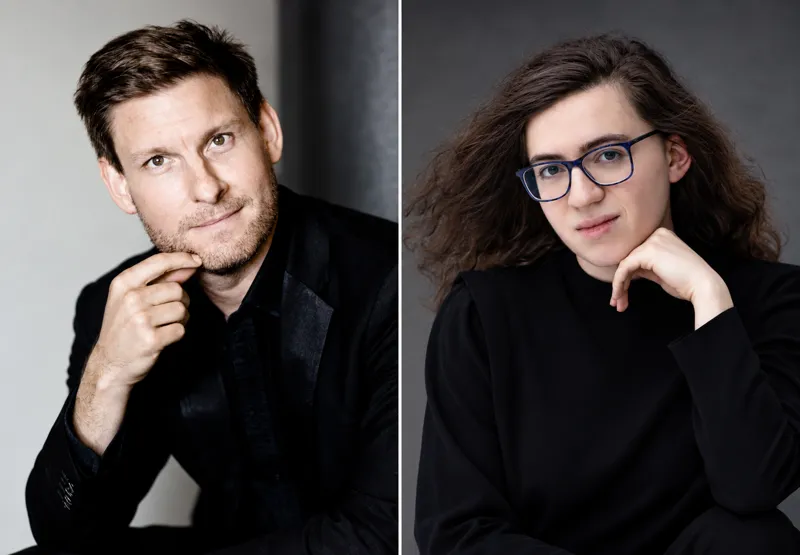
Kristian Bezuidenhout (left, photo © Marco Borggreve) and Marie-Ange Nguci (right, photo © Henrik Princeli).
Bezuidenhout’s program includes two earlier concertos, No. 14 in E-flat major and No. 5 in D major. His nimble buoyancy, technical brilliance, and subtle rubato are known quantities, and his interpretations are less rigid than those in the pioneering set by Malcolm Bilson and John Eliot Gardiner on Archiv. I have found some of Bezuidenhout’s earlier releases in this series slightly earthbound compared to Brautigam’s cycle (with the Kölner Akademie and Michael Alexander Willens), but these two new performances are simply excellent.
BIS’s engineering (for Brautigam) feels more open than what Harmonia Mundi provides here. The Freiburger Barockorchester strings are a bit grittier than their Kölner colleagues. Brautigam is significantly faster in both slow movements, and his readings have a lovely lyricism. But Bezuidenhout’s slower readings establish moodier atmospheres and at times feel almost improvised in the moment. I would not want to say one approach is better than the other; both prove captivating.
By my count, with this release Bezuidenhout has now recorded fourteen of the twenty-seven concertos, in a series that began in 2012. For those in the market for a complete cycle on period instruments, Brautigam remains the prime recommendation.
Recommended Comparisons
Mozart: Piano Concerto No. 20
Ronald Brautigam | Jean-Efflam Bavouzet | Malcolm Bilson | Clara Haskil
Mozart: Piano Concerto No. 22
Ronald Brautigam | Jean-Efflam Bavouzet | Malcolm Bilson | Mitsuko Uchida
Album Details — Nguci (Alpha) |
|
|---|---|
| Album name | Mozart: Piano Concertos Nos. 20, KV 466 & 22, KV 482 |
| Label | Alpha Classics (Next Generation Mozart Soloists, Vol. 16) |
| Catalogue No. | ALPHA1245 |
| Artists | Marie-Ange Nguci (piano, Bösendorfer VC 280), Mozarteum Orchestra Salzburg, Howard Griffiths (conductor) |
| Recorded | April 2023, Orchesterhaus Salzburg |
Album Details — Bezuidenhout (Harmonia Mundi) |
|
|---|---|
| Album name | Mozart: Piano Concertos K. 175, 449 & 466 |
| Label | Harmonia Mundi |
| Catalogue No. | HMM902759 |
| Artists | Kristian Bezuidenhout (fortepiano, Paul McNulty copy after Walter & Sohn, c. 1805), Freiburger Barockorchester, Cecilia Bernardini (concertmaster) |
| Recorded | January 2024, Ensemblehaus Freiburg |
