Roughly a decade before his first trip to England, Haydn composed the three symphonies heard on this album (Nos. 76–78) for a 1782 London trip that fell through. His new contract (1779) permitted him to sell music to others besides Prince Esterházy, so he offered the three scores to publishers in Vienna, Paris and London, writing to one that “Whoever pays me best will obtain my works; on the other hand, I assure you that you will make a tremendous profit with these three symphonies.” They are wonderful works, unfortunately overshadowed by the Paris and London symphonies.
Symphony No. 78 opens with an urgency in keeping with its C minor key, though the mood brightens with the second subject’s arrival in E-flat major. In the development both subjects are fragmented and tossed between various instruments; the voicing and transparency of this reading let us relish Haydn’s playful counterpoint. I anticipated Antonini’s tempo (marked Vivace) would be even speedier than Klumpp’s 7’36” with the Heidelberg Symphony Orchestra (Hänssler), but at 7’58” Antonini’s tempo seems exactly right.
The Adagio is spacious, again slower than Klumpp and Goodman (Hanover Band, Hyperion). Antonini certainly sustains the intensity of the long line better than Dantone with Accademia Bizantina (Decca). I love the ebb and flow in the Menuet (the Trio is particularly delightful), and the Finale (Presto) has the cut and thrust we expect from an Antonini performance. Yet here there is a subtlety and flexibility not apparent in earlier volumes in this series.
Symphony No. 77 is sunnier, less restless and far more genial. In earlier releases I have felt Antonini takes such music too sternly, but not so here. Again, against expectations the opening Vivace (9’41”) is substantially slower than Klumpp (8’43”) and Goodman (8’14”). The slow movement, played with muted strings, is quite breathtaking, followed by a driven Menuet and a thrilling Finale, one of Haydn’s first examples of sonata-rondo form. I sensed a real connection with the music’s humor, and real pleasure in it.
The program note states that Johann Christian Bach’s music was reputed to lack “his father’s seriousness and his brother Carl Philipp Emanuel’s originality,” but that the symphony heard here (Op. 6 No. 6 in G minor) “ought to dispose of [that reputation] once and for all.” Yet this powerful, emotion-laden Sturm und Drang work in three movements has already had several fine recordings in recent decades, from Halstead and the Hanover Band (CPO), Standage and the Academy of Ancient Music (Chandos), and Mai with the Akademie für Alte Musik Berlin (Harmonia Mundi). The more recent performance by Ian Page and The Mozartists (Volume 2 of their Sturm und Drang series, Signum Classics, 2020) is a full-bodied, raucous reading, with a particularly involving slow movement that this new reading does not eclipse.
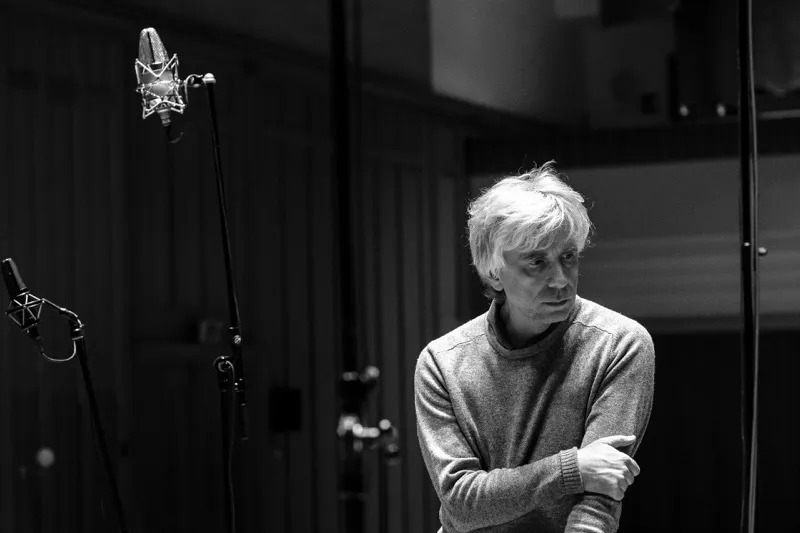
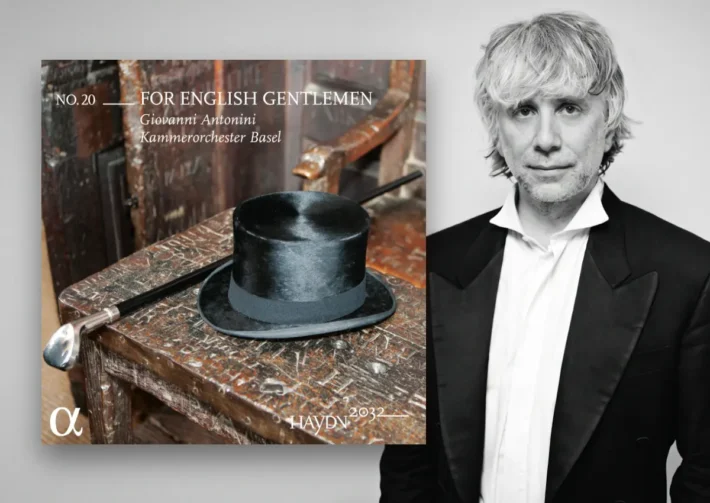
Giovanni Antonini. Photo © Federico Emmi.
The album concludes with Symphony No. 76. The polyphonic inventiveness of the opening movement is answered by a stately slow movement that in Goodman’s reading lasts almost as long as the final two movements combined. Antonini’s slightly quicker tempo, wedded to the finesse and silvery beauty of the Basel orchestra, makes a better case for playing every repeat, as does a chamber-music intimacy that I do not sense in Heidelberg. Müller-Brühl’s generally fine reading with the Kölner Kammerorchester (Naxos) is let down by this movement: at 10’34”, the slow movement feels even longer. The final two movements feature unexpected pauses meant to make us smile, and again the seriousness of earlier volumes seems replaced by a bigger grin from players and conductor alike.
Alpha’s excellent booklet includes an introductory note from Antonini, as well as Christian Moritz-Bauer’s interesting discussion of the music. A full roster of players and their instruments is included. At 85 minutes this is a generously filled program. While collectors of the series will surely need no recommendation from me, other readers wanting to fill a gap in their Haydn symphony discography should hear these readings of three less frequently recorded symphonies.
Recommended Comparisons
Haydn: Symphonies Nos. 76–78
Roy Goodman | Ottavio Dantone (No. 78)
J. C. Bach: Symphony in G minor, Op. 6 No. 6
Album Details |
|
|---|---|
| Album name | Haydn 2032, Vol. 20: For English Gentlemen |
| Label | Alpha Classics |
| Catalogue No. | ALPHA1102 |
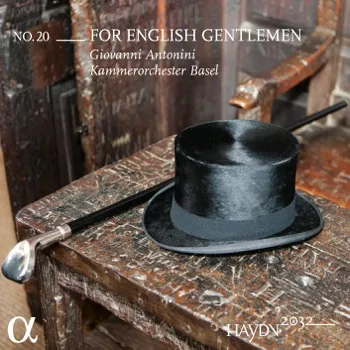
| Artists | Kammerorchester Basel, Giovanni Antonini (conductor) |