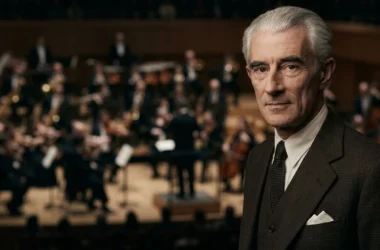
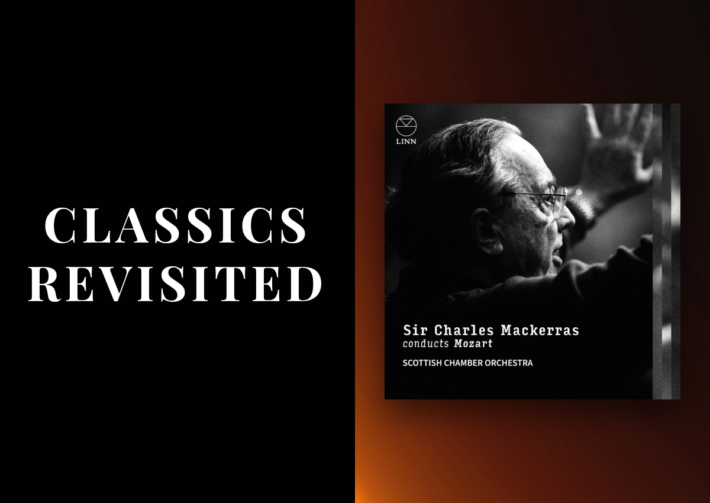
By the time Sir Charles Mackerras set down Mozart’s last four symphonies with the Scottish Chamber Orchestra at Glasgow’s City Halls, in August 2007, he was eighty-one and on his second pass through this music. His complete Mozart symphonies with the Prague Chamber Orchestra, recorded for Telarc between 1986 and 1991, was already a benchmark modern-instrument account in period-informed style. The SCO partnership was equally long-standing. Mackerras was the orchestra’s Conductor Laureate, and their earlier Telarc opera cycle (Figaro, Don Giovanni, Così, The Magic Flute) had shown how far a modern-instrument ensemble could travel toward period practice without losing its tonal body. The Linn symphonies, released in 2008, extended that logic to the concert repertoire.
The moment was unusually contested. By the late 2000s, Mozart on modern instruments had been living for a generation in the shadow of the period-instrument movement. Pinnock, Hogwood, Brüggen and Gardiner had all made their marks on this repertoire, while the older modern-orchestra tradition of Böhm, Walter, Jochum and Klemperer had become, in its turn, a historical object. A new modern-instrument cycle had to answer a simple question: what does it offer that neither side already provides?
Mackerras’s response was to absorb the arguments of both. The SCO is chamber-sized and fleet. Strings are lean, with vibrato treated as a colour rather than a default. The brass is entirely period (natural horns and natural trumpets), and the timpani crisp and forward. Tempi are brisk, rhythmically exact, and never stretched for effect. The wind solos, especially the clarinets in the Jupiter and the oboe writing in the G minor, retain a singing, operatic inflection that is pure late-Mackerras and a direct inheritance from the Telarc opera years. Repeats are observed throughout, including the development-section repeats that most conductors skip. The scale of the forces is small enough for counterpoint to register clearly and large enough for the tuttis to carry body.
What emerges is Mozart heard as a dialogue between two worldviews rather than a position statement for either. The Jupiter finale is as cleanly articulated as any period-instrument reading, but the horns and winds keep tonal substance. The slow movement of No. 39 has the grace of the old Viennese tradition without the sag. The G minor first movement is fast and troubled but never brittle. The slow movement of the Prague is particularly fine: shapely, unhurried, alert to inner voices.
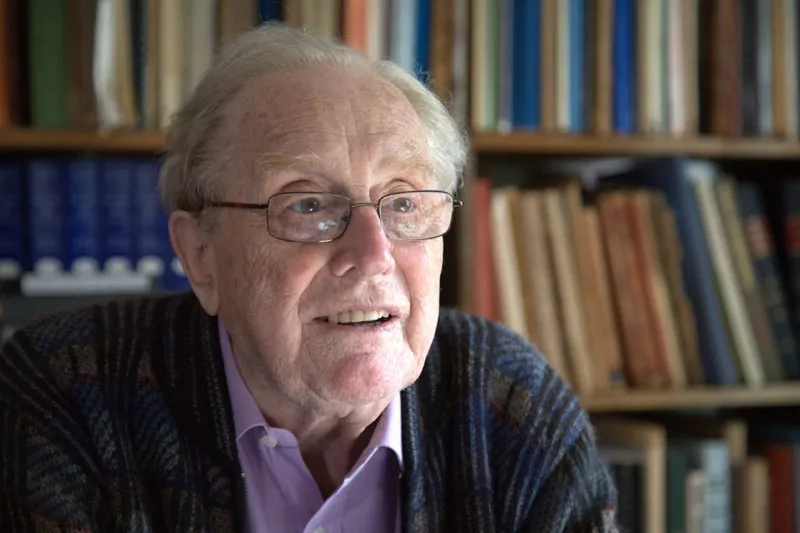
Sir Charles Mackerras (© Festival Moravský podzim)
Heard against the earlier Prague reading, the SCO set shows what has changed. The interpretive framework is the same: brisk tempi, period sensibility, modern ensemble. But the commitments are tighter. The brass is now period, with natural horns and trumpets replacing modern ones. The engineering has more air around the orchestra. And the playing reflects two further decades of period-practice thinking, absorbed now into the orchestra itself. It is Mackerras returning to his own argument with the consensus around it having moved on.
Reception was emphatic. The set took the 2009 BBC Music Magazine Disc of the Year and Orchestral Award, the Classical BRIT Critics’ Award, a Midem and a Choc de l’année. BBC Music Magazine later placed it among its essential Mozart recordings in 2012. In the years since, it has remained a standard reference in modern-instrument late Mozart, usually cited alongside Harnoncourt and the Chamber Orchestra of Europe among the few such sets that continue to be actively listened to.
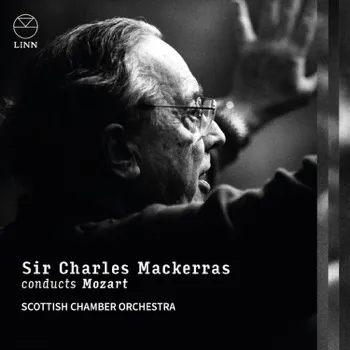
Linn has now gathered the SCO’s Mozart work with Mackerras into Sir Charles Mackerras Conducts Mozart (CKD786): the nine symphonies (Nos. 29, 31, 32, 35, 36, 38–41), the Requiem in Robert Levin’s completion, and the K546 Adagio and Fugue. It was released in November 2025 as a five-disc box. Revisited in 2026, the late symphonies sit even more comfortably than they did on release. The period-instrument orthodoxy has relaxed, and the heavier modern tradition has faded further. Mackerras’s hybrid reading — principled, flexible, unshowy — looks increasingly like the position that has aged best. It is, in the best sense, a sensible recording, and sensible is an underrated Mozartian virtue.
Album Details |
|
|---|---|
| Album name | Sir Charles Mackerras Conducts Mozart |
| Label | Linn |
| Catalogue No. | CKD786 |
| Artists | Sir Charles Mackerras, conductor; Scottish Chamber Orchestra; Susan Gritton, soprano; Catherine Wyn-Rogers, mezzo-soprano; Timothy Robinson, tenor; Peter Rose, bass; Scottish Chamber Orchestra Chorus |