Johannes Brahms did not set the Latin Mass for the dead. Instead he chose his own texts from Luther’s translation of the Bible, and the result is a work of comfort for the living rather than a prayer for the departed. He wrote most of it between 1865 and 1868, in the years after the death of his mother, which is thought to have prompted it. Brahms conducted a six-movement version in Bremen Cathedral on Good Friday 1868 with great success. He then added a movement for soprano, and the complete work was first performed in Leipzig in February 1869.
The Requiem calls for soprano and baritone soloists, chorus and orchestra, with a harp and an optional organ. Its seven movements form an arch, from Selig sind, die da Leid tragen (“Blessed are they that mourn”) to Selig sind die Toten (“Blessed are the dead”). The chorus carries most of the work, while the baritone leads the third and sixth movements and the soprano sings only in the fifth. Recordings range from broad readings with large choirs to quicker, leaner versions on period instruments with smaller choirs.
Here are The Classic Review editorial team’s recommendations for the 10 best recordings of Brahms’s A German Requiem (“Ein deutsches Requiem”).
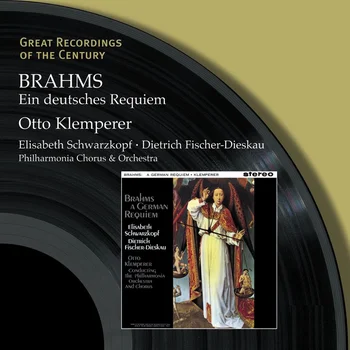
Philharmonia Orchestra, Otto Klemperer
For decades, the studio recording Otto Klemperer made with the Philharmonia Orchestra in 1961 has been the standard choice. His reading is plain and unsentimental, monumental in scale yet not ponderous. He holds a steady pace, so each movement hangs together from beginning to end. Elisabeth Schwarzkopf and Dietrich Fischer-Dieskau are an outstanding pair of soloists. The Philharmonia Chorus is less polished than the best choirs of today, but it sings with feeling.
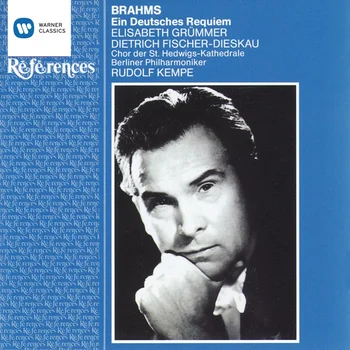
Berlin Philharmonic Orchestra, Rudolf Kempe
Rudolf Kempe’s 1955 recording with the Berlin Philharmonic leans toward consolation rather than force. At about 76 minutes, it runs some seven minutes longer than Klemperer’s. Yet Kempe adjusts the pace so skillfully that the length is never a burden, and he keeps a firm hold on the drama. The St Hedwig’s Cathedral choir is fresh and well blended, and although the mono sound is limited and has some hiss, nothing essential is lost. The high point is the fifth movement, where Elisabeth Grümmer sings with a warm, bright tone.
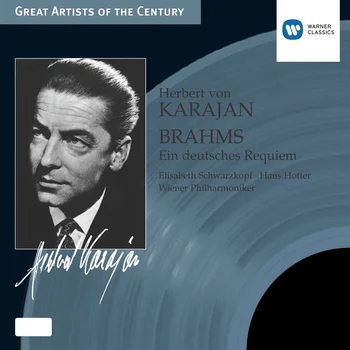
Vienna Philharmonic, Herbert von Karajan
Only two years after the war, in 1947, Herbert von Karajan made his first recording of the work in Vienna, and it was the first complete studio recording of the Requiem. The performance is more intense than he usually was, with slow tempos and a patient flow. The long second movement is paced to give a feeling of great breadth, and the fourth movement is peaceful and reverent. Hans Hotter sings the baritone solos in a dark, beautiful voice, with close attention to the words. The drawback is the sound: cloudy, constricted mono, with the voices clear but the orchestra blurred behind them. Even so, the performance’s sense of hope and conviction comes through.
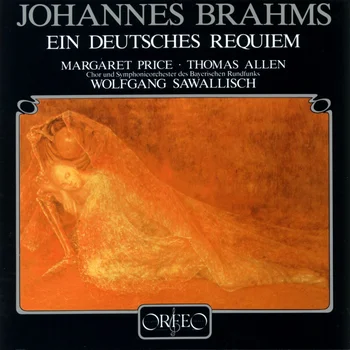
Bavarian Radio Symphony Orchestra, Wolfgang Sawallisch
Made in the mid-1980s, some two decades after his first, Wolfgang Sawallisch’s second recording of the work is built around two superb soloists. Thomas Allen brings real grief to the baritone solos of the third movement, and Margaret Price’s soprano is resonant and radiant. Around them, Sawallisch and the Bavarian Radio Symphony Orchestra and Chorus give a grave, unhurried reading with natural phrasing. The result is very moving.
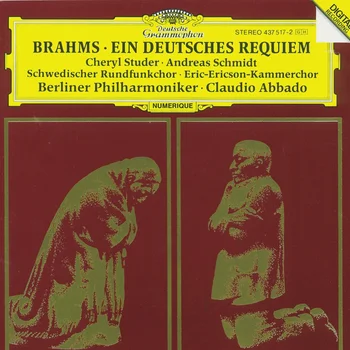
Berlin Philharmonic Orchestra, Claudio Abbado
Claudio Abbado’s live 1992 recording with the Berlin Philharmonic is a showcase for its choirs. The Swedish Radio Choir and the Eric Ericson Chamber Choir sing beautifully, and their lines stay smooth and clear. His tempos are broad, and the singers never swamp the orchestra: the cellos, the second violins and an oboe solo all come through.
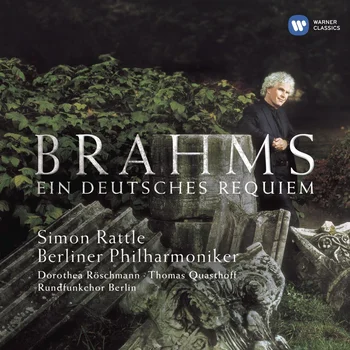
Berlin Philharmonic Orchestra, Simon Rattle
Like Abbado’s, Simon Rattle’s 2006 live recording with the Berlin Philharmonic takes a traditional approach, with broad tempos that never lose their focus. The pacing convinces across the whole work and from one passage to the next, and the climaxes are well judged. The Rundfunkchor Berlin is attentive throughout, and even in the fugues the choir’s lines stay distinct. The fourth movement has a gentle, dance-like lilt, and the last movement glows. On some playback equipment, the orchestra in particular can sound a little bass-heavy and muffled. It is a carefully considered, beautifully played performance.
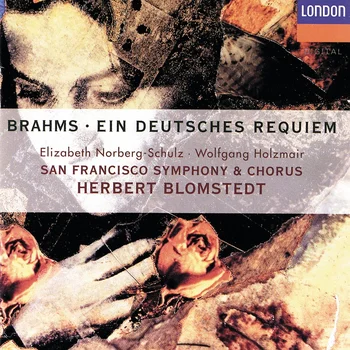
San Francisco Symphony, Herbert Blomstedt
Among modern recordings, Herbert Blomstedt’s 1993 version with the San Francisco Symphony has long been a reference. The performance is strong and full-bodied, and the orchestral solos are finely played. At times, though, his restraint holds back the biggest climaxes, and the soloists have rather light voices. The San Francisco Symphony Chorus is at its finest in the softest passages.
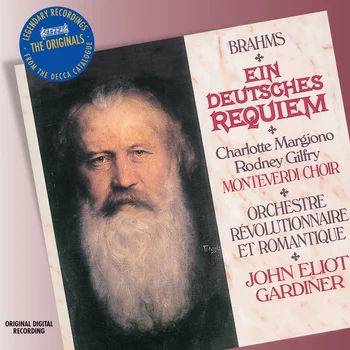
Orchestre Révolutionnaire et Romantique, John Eliot Gardiner
John Eliot Gardiner’s 1990 recording, the first of his two, showed how different the work could sound on period instruments. With fewer singers and a lighter orchestra, he takes quicker speeds than most, while following the composer’s markings for loudness and phrasing closely. The performance brings out Brahms’s debt to Baroque choral music, and the Monteverdi Choir sings precisely, with every word clear. It remains a sharp contrast to the big-orchestra versions above.
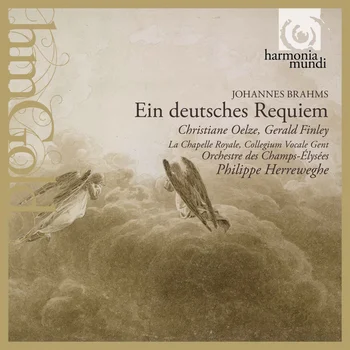
Orchestre des Champs-Élysées, Philippe Herreweghe
Six years after Gardiner, Philippe Herreweghe recorded the work live with a period-instrument orchestra, and the result is warm in tone and finely balanced. The speeds are brisk, and the strings play without vibrato. The soloists, Christiane Oelze and Gerald Finley, fit the music well. Above all, his two choirs, Collegium Vocale Gent and La Chapelle Royale, merge into one blend in which no voice part dominates.
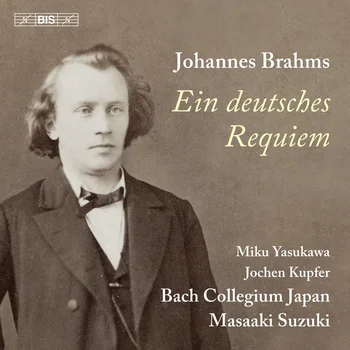
Bach Collegium Japan, Masaaki Suzuki
Bach Collegium Japan’s choir has only 36 singers, yet in Masaaki Suzuki’s 2024 recording it never sounds thin. His tempos are moderate, and the textures are so open that small details stand out, such as the horn figures early in the first movement. Jochen Kupfer sings the baritone solos easily and expressively, and Miku Yasukawa’s soprano solo is pure in tone. The passage at the heart of the last movement, where the Spirit promises rest to the dead, is the emotional peak of the performance.
Top image ©️ The Classic Review, AI generated