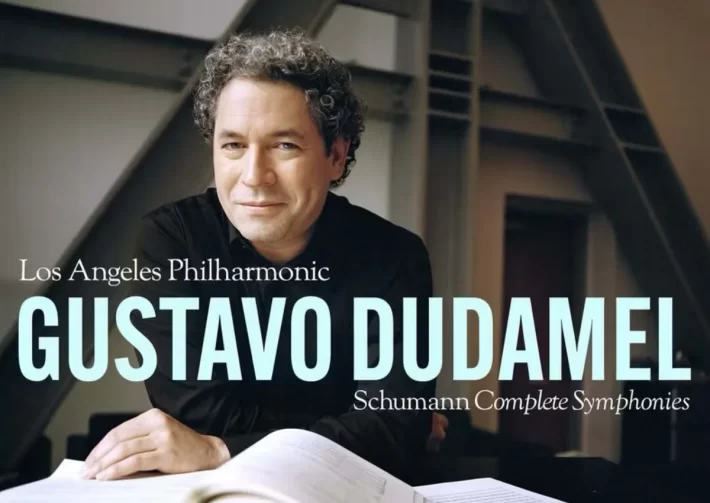
To someone who still buys physical CDs, following the partnership of Gustavo Dudamel and the Los Angeles Philharmonic over the past several years has proven frustrating, since most of their albums are available via download or streaming only. I enjoyed their 2021 Ives symphony cycle, the Dvořák Symphonies Nos. 7-9 (2022), and their thrilling account of Prokofiev’s complete Romeo and Juliet, released earlier this year. (All of these are on DG, though only the Ives is available as a physical product.) Now Dudamel and the orchestra present Schumann’s four symphonies, recorded live in 2018 and released by Platoon.
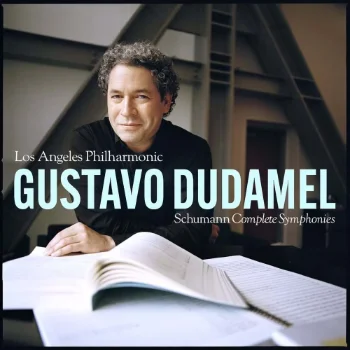
In excellent liner notes, Andrew Mellor writes that Schumann’s first symphony “reaches heights of joyousness that he would never quite attain again.” That joy is the chief characteristic of Dudamel’s reading. It is played with infectious energy, tempos lean toward the faster end of the spectrum, and the orchestra’s unanimity of attack and articulation is a constant delight. The strings have a luscious sheen, with distinctive woodwinds and bright, resonant brass. The Cleveland recordings of Szell and Dohnányi (Sony and Decca) may offer an even greater level of technical finesse, but neither reaches the “heights of joyousness” heard in Los Angeles.
In the second symphony, Dudamel seems hesitant to engage with the work’s darker emotional terrain. This is not a programmatic work, but I believe it captures a progression from debilitating depression to joyful health. (Schumann wrote: “I wrote the symphony…when I was unwell… I began to feel more myself when I wrote the last movement, but it was only after I had completed the whole score that I felt any better.”) In the first movement’s development, the disintegration of melodic material and harmonic instability express those struggles, as does the obsessively repeating figure driving the music toward the end of the movement. With Dudamel those moments are too easy, lacking the intensity heard in readings by Bernstein (Vienna Philharmonic/DG) and Luisi (Vienna Symphony/Orfeo).
After a brilliantly played Scherzo (with a thrilling Coda), the deeply felt, sweetly sung slow movement minimizes the agony heard in those Viennese recordings. The triumphant final movement is excitingly played but has less emotional power because the victory was too easily reached.
The Rhenish is more successful: the horns bray thrillingly in the opening movement, and the Scherzo is lithe and playful. I found the third movement less convincing, lacking the delicate balletic quality of the best performances; perhaps the engineered sound has an ambience that casts a gauze over the softer playing. But the fourth movement brings a potent sense of brooding and wonder, followed by a high-spirited finale in which the horns again excel, finishing with an exultant Coda.
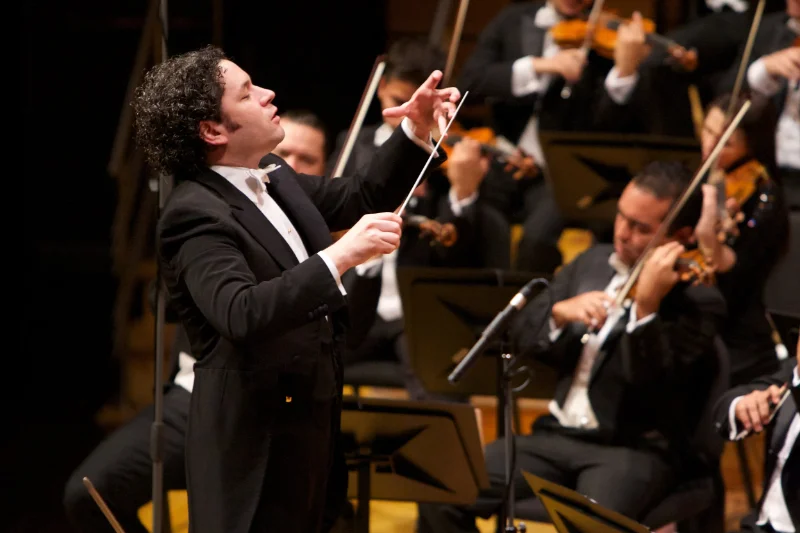
Gustavo Dudamel.
The reading of the fourth symphony is in some ways the most interesting, because Dudamel makes original interpretive choices. The opening movement is slower than Szell, Dohnányi, Karajan (Vienna/DG), and Luisi, and Dudamel chooses to relax into that tempo instead of creating a sense of forward propulsion. This generates a gentler, more settled mood than any other performance I know. The Romanze is forlorn and achingly tender, followed by a lithe and elegant Scherzo, though I feel Dudamel’s Trios veer into sentimentality. The final movement again downplays the darker moments — I am used to something stormier (like Karajan’s final 1987 account with the Vienna Philharmonic). I am not entirely convinced that this reading is what Schumann intended, but it intrigued me each time I listened and made me think about this symphony in a different way.
The liner notes (not readily available on all platforms) include biographical sketches of the orchestra and conductor, a full orchestral roster, and Mellor’s erudite essay. As noted above, the recordings were made eight years ago; why did it take so long to release them? Perhaps a decision was made to release them now to honor the seventeen-year partnership between this orchestra and its outgoing Music Director. That is something worthy of celebration, and I hope that Dudamel’s tenure with the New York Philharmonic will be just as fruitful.
Recommended Comparisons
Schumann: Complete Symphonies
George Szell | Christoph von Dohnányi | Leonard Bernstein | Fabio Luisi