Mozart completed the Clarinet Concerto in October 1791, less than two months before his death, for his friend Anton Stadler. Writing to his wife from Prague that month, he reported that he had nearly finished scoring the finale. Stadler most likely gave the first performance in Prague a few days later, though no program from the concert survives. It was the last concerto Mozart finished, and the autograph has been lost. All that remains in his hand is an earlier sketch of the first movement, written for basset horn.
Stadler played a basset clarinet, which reached four semitones below the standard instrument, and Mozart used that extra depth. When the concerto was first published in 1801, the solo part was rewritten for the ordinary clarinet in A. That version held the stage for a century and a half. The orchestra is small: strings, two flutes, two bassoons and two horns, with no oboes, so the wind color sits high and light around the soloist. The three movements run from a spacious Allegro through a long-breathed Adagio to a Rondo finale. Recordings now divide between the familiar 1801 text and reconstructions of the basset original, and that choice shapes both the tone and the reach of the solo line.
Here are The Classic Review editorial team’s recommendations for the best recordings of Mozart’s Clarinet Concerto.
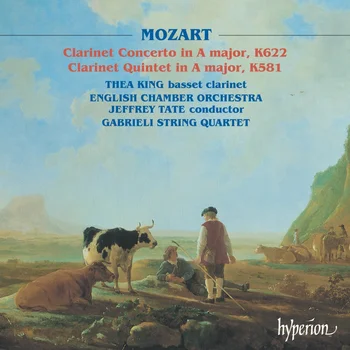
Thea King, English Chamber Orchestra, Jeffrey Tate
Thea King’s 1985 recording did more than any other to make the basset clarinet a working choice for this concerto. It remains the yardstick for everyone who has played it that way since.
Her phrasing is the first thing you notice. Long lines are broken into small, searching units, each given its own shape, yet nothing sounds fussy. She plays a modern-system instrument and uses the reconstructed solo part with adjustments of her own. Lyrical breadth sits beside darker, more shaded moments, and she gives full weight to the loud passages when the music asks for it. In the Adagio she draws on the cooler upper register to touching effect and leads back to the theme with a short, unforced cadenza. The finale signs off with a wink, a dive to the bottom of the range and a trill. Jeffrey Tate and the English Chamber Orchestra play with clarity and poise, and the Clarinet Quintet completes the disc. Next to the recordings that followed, hers is the broader, more traditional one, and for many that is exactly its appeal.
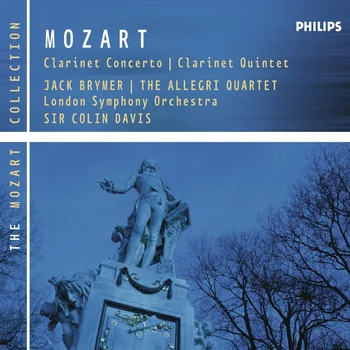
Jack Brymer, London Symphony Orchestra, Colin Davis
Where King builds the line from its details, Jack Brymer sings it whole. This 1964 recording with Colin Davis and the London Symphony Orchestra is the classic account of the concerto on the ordinary clarinet, in the text most people grew up with.
Davis keeps the orchestra alert, with a lift in the rhythm and plenty of drive, always held in elegant check. Brymer’s tone is gentle and sustained, with a warm glow around every note, and his manner has an unhurried grace that belongs to an earlier age of playing. He never loses the shape of the long phrase. Tempos are quicker than in the most spacious versions of the piece, which makes the outer movements more exciting and a little less consoling. The Allegri Quartet joins him for the Clarinet Quintet. Listeners who want the concerto as they know it from the concert hall, without the extra low notes, should start here.
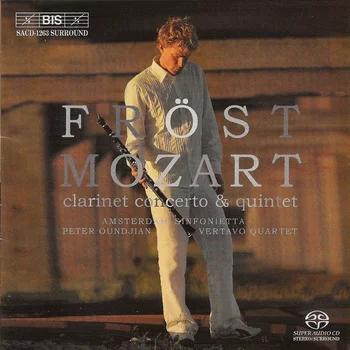
Martin Fröst, Amsterdam Sinfonietta, Peter Oundjian
The quietest playing on this list is here. Martin Fröst, recorded in 2002 with the Amsterdam Sinfonietta under Peter Oundjian, controls dynamics down to a whisper, and those pianissimos are the memory the disc leaves behind.
The Adagio is the heart of the performance, inward without turning solemn, shaped as one unbroken arc. He makes the most of the contrast between the high and low voices of his instrument, whose bottom register is dark and smoky. The outer movements are buoyant and nimble, with a springy opening. The accompaniment is refined and well balanced, and the Vertavo Quartet joins Fröst for the Clarinet Quintet. The result can seem cool precisely because it is so immaculate, and one or two of the whispered passages sound overdone. If the slow movement is what you listen for, this is the version to hear.
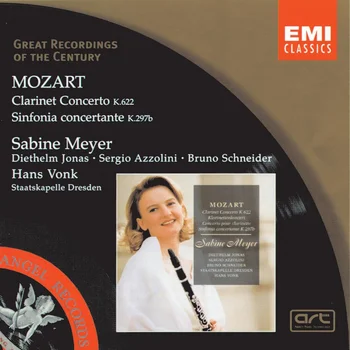
Sabine Meyer, Staatskapelle Dresden, Hans Vonk
Sabine Meyer and Hans Vonk sound like partners here rather than soloist and accompanist. Their 1990 recording with the Staatskapelle Dresden pairs exuberance with poignancy, and it has a confident directness.
Where Fröst turns inward, Meyer is outgoing, and Vonk matches her with an orchestra that has life in it from the opening to the last bar. She takes the long descending runs of the first movement with complete control, and moves between detached and slurred notes without a seam. Her tone is deeper and rounder than the ordinary clarinet’s, and it stays even from top to bottom. The Sinfonia Concertante for winds fills out the disc. Anyone who prizes the slower, more majestic manner of the classic readings may want more repose than she offers. The pacing is close to Brymer and Davis, and the result stands fully beside them.
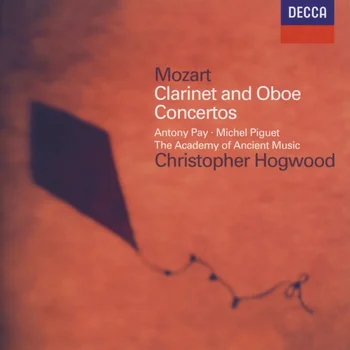
Antony Pay, Academy of Ancient Music, Christopher Hogwood
Antony Pay plays a modern copy of a period basset clarinet, and Christopher Hogwood’s Academy of Ancient Music matches him with instruments of Mozart’s time. Recorded in 1984, this is the historically minded choice here, and it is bold, energetic and dance-like.
Every phrase is articulated with personality, his added decoration is tasteful, and the Rondo goes with a thrilling ease. The old-style clarinet has a reedy, liquid sound that sets it apart at once from the familiar tone, and he colors it softly and naturally. Hogwood drives the tuttis with spirit and leaves the soft passages open and uncluttered. Later recordings of this historical kind bring more nuance, and this one stays plainer and simpler. The Oboe Concerto, with Michel Piguet, makes the coupling. Choose it if you want the concerto as its first audience might have heard it, ornaments and all.
Top image ©️ The Classic Review, AI generated