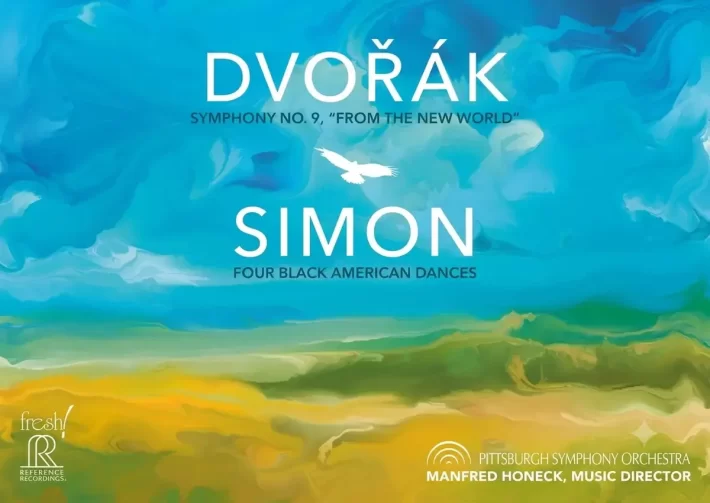
This is the latest Reference Recordings release from Manfred Honeck and the Pittsburgh Symphony Orchestra, and it is an excellent one: scrupulously prepared and played with great precision. In recent weeks I have listened to two Cleveland performances of Dvořák’s symphony (Szell on Sony Classical, Dohnányi on Decca), both recognized for their brilliant playing. Honeck and his players now match, and perhaps exceed, the ensemble unanimity and chamber-music sensitivity that distinguish those Cleveland albums. Neither of the older recordings offers engineering that equals the warmth, range, and transparency Reference achieves in Pittsburgh.
In past reviews I have noted that Honeck’s interpretive ideas (unmarked dynamic tweaks, distinctive articulation and phrasing) occasionally cross into mannerism, and this new recording of the ‘New World Symphony’ has several examples. The most audible is an unmarked crescendo, not always but most often in the brass, applied to the second theme between the end of the antecedent phrase and the start of its consequent. On repeated listening I found it less distracting.
Honeck also reshapes a crescendo (track 1, 2’17″) to make it more dramatic and, more radically, alters the timpani part around 2’33″, arguing in his notes that the timpani of Dvořák’s day could not do what he intended but modern instruments can. Finally, where many conductors pull back for the third theme (the flute solo at 6’45″), Honeck slams on the brakes, dropping to a substantially slower tempo for several measures before returning to speed. All these tweaks drew my attention from the music to the interpretation.
Honeck’s reading of the slow movement takes its cue from the composer: “The second movement is a kind of Adagio, but one that differs from the classical form… it is in reality a study or sketch for a longer composition… after Longfellow’s Hiawatha.” It is beautiful: the opening and closing wind chorale has an organ-like sonority, and Ian Woodworth’s English horn solo is superb.
The issue for me is that Honeck treats the music like a miniature tone poem, its dynamics and rhetorical gestures implying an unwritten program. That comes at the expense of any folk-like simplicity, and many hear this movement as a reflection of Native American and Black American melody. Bychkov (Czech Philharmonic, Pentatone) and Mackerras (Prague Symphony, Supraphon) take the plainer route, both a good deal faster, and I find their approach more convincing. Others will disagree.
The last two movements are wholly successful, largely because there is less interpretive intervention and the orchestra is free to play with real artistry. Honeck and his players draw out a folksy warmth in the Scherzo’s Trio.
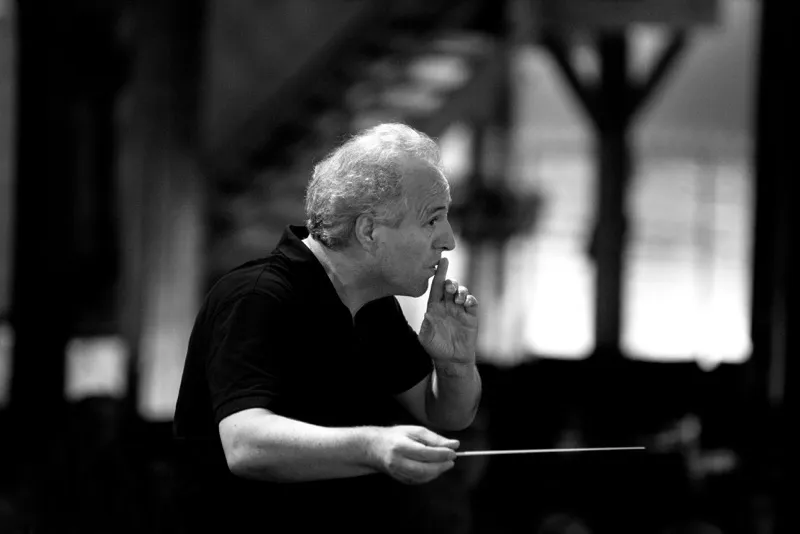
Manfred Honeck. Photo © Felix Broede
A few decades ago, critics sometimes wrote that Karajan’s Berlin recordings were too beautiful, so shaped and polished that they lost their humanness. I never understood the argument, yet here I feel something like it. I cannot fault the reading’s technical accomplishment, nor Honeck’s clear vision and his ability to realize it fully. What I miss is the vulnerability, the of-the-moment spontaneity that makes the recordings by Nelsons (Bavarian Radio Symphony, BR Klassik) and Stutzmann (Atlanta Symphony, Warner Classics) so moving.
Carlos Simon’s Four Black American Dances makes a well-chosen coupling. Commissioned by the Boston Symphony Orchestra and Andris Nelsons, the work opens with the ecstatic Ring Shout, which lets the Pittsburgh players embrace their jazzier side. The Waltz is gently affecting, not least because Honeck draws a line to the sensuous writing of Strauss’s Der Rosenkavalier.
The closing Holy Dance mimics a congregation speaking in tongues, building to a riotous Coda that levels off, unexpectedly, into a simple plagal cadence. Honeck and the orchestra bring the same attention and commitment here as in the symphony, and it is hard to imagine a better account.
Album Details |
|
|---|---|
| Album name | Dvořák: Symphony No. 9 “From the New World”; Simon: Four Black American Dances |
| Label | Reference Recordings |
| Catalogue No. | FR-769SACD |
| Artists | Pittsburgh Symphony Orchestra; Manfred Honeck, conductor |