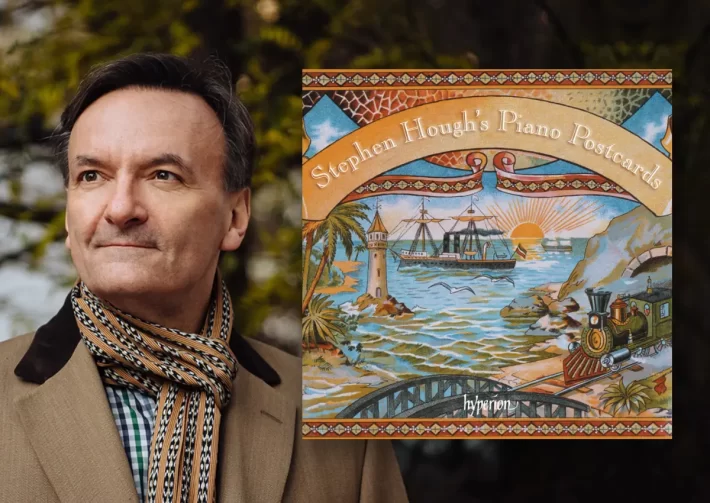
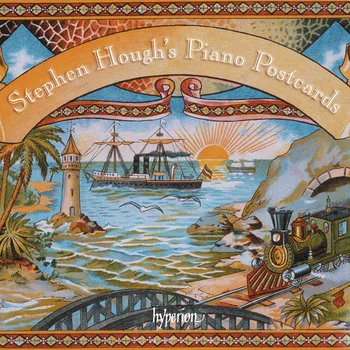
Sir Stephen Hough’s latest album, Piano Postcards, draws on a wide variety of musical genres. The program blends highlights from Disney films, classical piano repertoire, and international folk music. Many of the selections are Hough’s own transcriptions, continuing the pianist-composer tradition he has championed on previous releases.
The album opens with a three-movement suite from Mary Poppins. Hough’s reading of Chim chim cher-ee (track 1) brings a wistful nostalgia to the jaunty original. His technical finesse is evident throughout, the passagework clear and lithe.
Feed the birds (track 2) captures a deep warmth, drawn from his careful control of the instrument’s middle register. The finale (track 3) closes the suite with energy and unfailing playfulness. Hough approaches the three songs much like a classical sonata, giving the set structural unity while letting each stand on its own.
Moving to a different corner of the world, Hough turns to Taiwanese Hokkien and Japanese traditions, shedding welcome light on non-Western melodies. His Spring breeze prelude (track 8), by Hakka composer Deng Yu-Hsien, brings out the beauty of the original tune in a clever arrangement. Its opening bars quote Rachmaninoff’s Prelude in G major, Op. 32 No. 5, establishing a flow with the Russian repertoire heard earlier. The harmonies are colorful and lush, though the accompaniment occasionally feels too pervasive, obscuring the delicate main melody.
Aka tombo (track 9), a widely recognized Japanese song, receives a transcription of real depth. Hough’s melodic playing captures the natural beauty of the original.
Hough includes further Disney arrangements later in the program. His Reflection from Mulan (track 11) is a high point, turning an already famous song into something richer and more complex. He threads the theme through several voices against lush textures, giving it a neo-Romantic cast that carries his virtuosity lightly.
The arrangement of Do you want to build a snowman? from Frozen (track 10) is similarly intelligent. Hough builds his transcription on the song’s opening motif, and the delicate filigree accompaniment serves a programmatic purpose too, depicting falling snow.
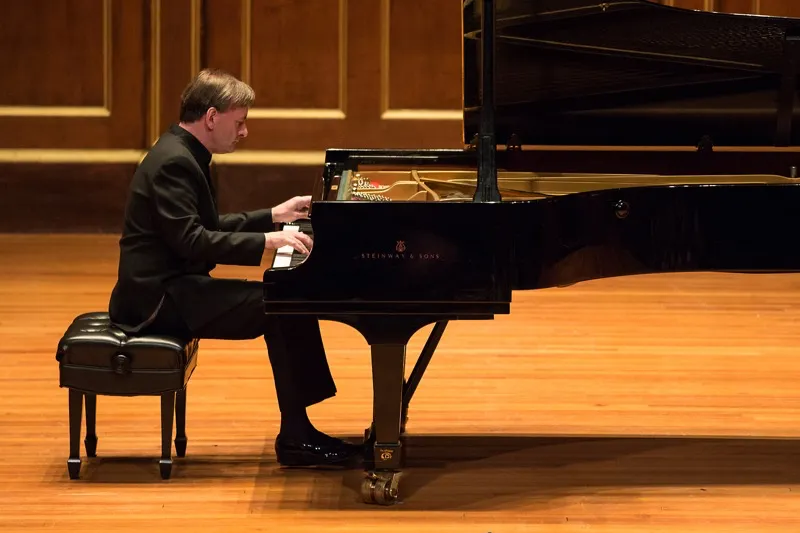
Stephen Hough. Photo © Robert Torres.
The more conventional repertoire is just as strong. Rachmaninoff’s Prelude in G sharp minor (track 5) shows exquisite voice-leading and a sparkle in the accompaniment. In The flight of the bumblebee (track 7), the passagework is a delight, though the interpretation leans toward a surprisingly gentle character rather than an aggressive one.
The lesser-known gems are especially rewarding, particularly the works of Cécile Chaminade. Her Toccata (track 16) is a showpiece that keeps a delicate, meticulous edge even at its most spirited. Hough holds these contrasts in balance, and the reading is both exciting and refined.
Les sylvains (track 18) sets soothing, idyllic outer sections against a lively central episode. Hough moves between the two moods so that the whimsical middle feels like a natural outgrowth rather than a break.
Piano Postcards is not the first thematic curation of eclectic miniatures, but it is one of the most thoughtful. No work or genre feels chosen at random to make the program accessible; instead, a narrative emerges through small details and musical quotations. Together, the transcriptions and the performances confirm Hough’s standing among the finest of today’s pianist-composers.
If you enjoyed this album, also hear
Hough: Dream Album | Hough: New Piano Album | Hamelin: Kaleidoscope | Volodos: Piano Transcriptions