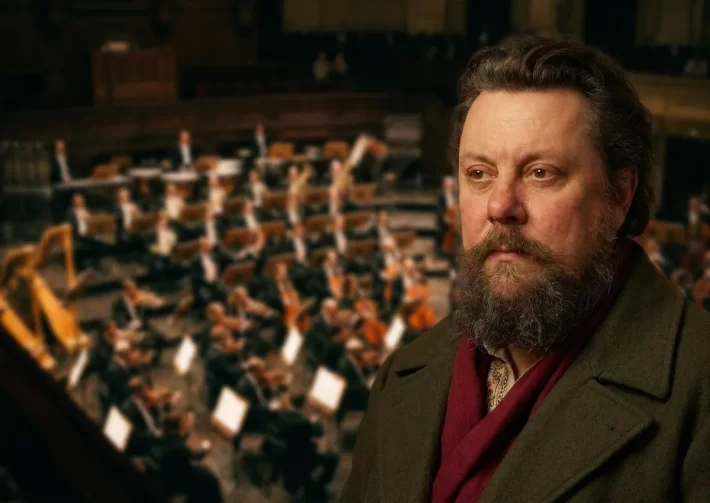
Modest Mussorgsky composed Pictures at an Exhibition in 1874, when he was thirty-five, writing the original piano suite in barely three weeks. It was a tribute to his friend the artist and architect Viktor Hartmann, who had died the year before, and its ten movements respond to works shown at a memorial exhibition of Hartmann’s designs. The suite was little known in the composer’s lifetime, and it reached a wide public not as a piano work but through later orchestrations, above all the one Ravel made in 1922.
Ravel’s orchestration was commissioned by the conductor Serge Koussevitzky, who led the first performance in Paris in 1922. It calls for a large orchestra, with an alto saxophone for the wistful Old Castle, two harps, celesta and a wide battery of percussion. A recurring Promenade carries the listener between the pictures, from the scurrying Gnomus to the towering Great Gate of Kiev. Because Ravel’s orchestration is above all a showcase for orchestral colour and weight, recordings are separated less by their notes than by their sound, and the readings below answer that challenge in very different ways.
Here are The Classic Review editorial team’s recommendations for the best recordings of Mussorgsky’s Pictures at an Exhibition in Ravel’s orchestration.
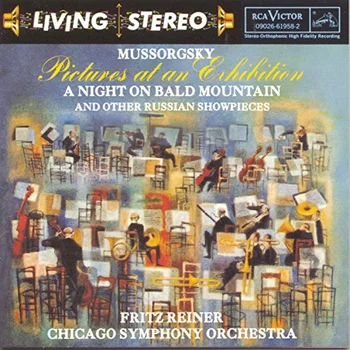
Chicago Symphony Orchestra, Fritz Reiner
Fritz Reiner’s 1957 account with the Chicago Symphony Orchestra remains the reference by which most others are still measured. Its appeal lies not in opulence or sheer mass, but in clarity, precision and a fearless orchestral discipline.
Reiner keeps the textures transparent, so the inner detail of Ravel’s scoring registers cleanly even at speed. The bright trumpet of the opening Promenade sets a confident tone, and the playing that follows has an accuracy that still sounds startling. Gnomus draws its menace from rhythmic bite rather than volume, while the Ballet of the Unhatched Chicks is pointed and weightless. Where later versions court size, this one prizes definition and forward motion. The early stereo sound is leaner than modern rivals, yet it loses almost nothing in impact. It is the first choice for listeners who want orchestral virtuosity above all, and the recording that effectively defined the work on disc.
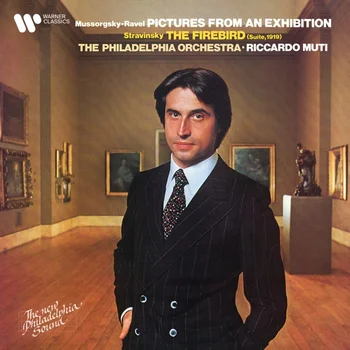
Philadelphia Orchestra, Riccardo Muti
In Riccardo Muti’s hands, the Philadelphia Orchestra of 1978 presents the work as pure orchestral spectacle. This is not a lean or analytical reading, but a broad and richly upholstered one, built on famous strings and a brass section of tremendous power.
Muti lets the music expand, and the playing has a sheen and fullness that few rivals match. The alto saxophone of The Old Castle sings with unusual warmth, and the bustle of Tuileries is full of darting colour. The climaxes arrive with real force, and The Great Gate of Kiev opens out massively, weightier and more sumptuous than Reiner allows. Some listeners may find the approach more concerned with sound than with character, but the sound itself is glorious. It is a strong choice for anyone who wants the score at its most opulent and overwhelming.
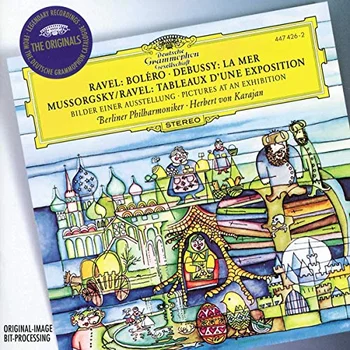
Berlin Philharmonic, Herbert von Karajan
Recorded in 1965, Herbert von Karajan’s reading with the Berlin Philharmonic takes a grander, more sumptuous view than most. Its aim is not raw earthiness, but beauty of sound, long line and a sense of controlled splendour.
Karajan smooths the work’s rougher edges and draws a deeply blended tone from the Berlin strings. The recurring Promenade is broad and unhurried, lending the sequence a processional grandeur. Bydło rises and recedes as one long crescendo, the oxcart approaching and passing without any jolt, while the gloom of the Catacombs is held in a hushed stillness. The result is broader than Reiner and less overtly theatrical than Muti, and it can feel polished where others feel rugged. Yet the playing is magnificent and the long line never sags. It suits listeners who value tonal beauty and breadth above grit and surprise.
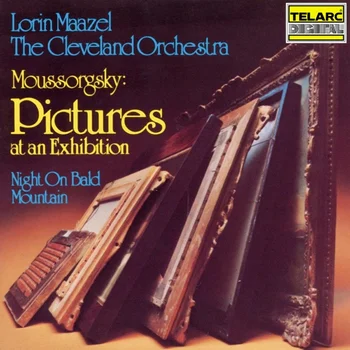
Cleveland Orchestra, Lorin Maazel
Few recordings announced the digital era as loudly as Lorin Maazel’s 1978 version with the Cleveland Orchestra. Its reputation rests not on interpretive daring, but on a spacious, almost physical sound that still impresses today.
Maazel takes a measured, weighty approach that lets the Cleveland precision tell. The horns ring out brilliantly from the very opening, and the percussion lands with unusual depth and definition. The two figures of Samuel Goldenberg and Schmuÿle are sharply drawn, the muted trumpet wheedling against the heavy strings. The Hut on Fowl’s Legs gathers real momentum, and Maazel grows in stature as the second half builds. This is not the last word in orchestral fireworks, and Reiner’s players sound the more daring, but few versions match this one for sheer impact. With Night on Bald Mountain alongside, it is a fine choice for listeners who prize demonstration-quality sound.
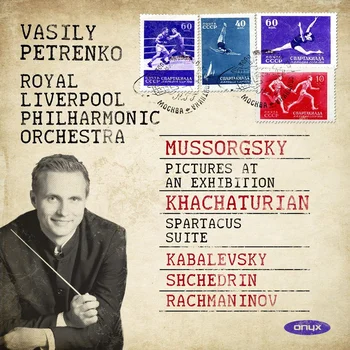
Royal Liverpool Philharmonic Orchestra, Vasily Petrenko
The newest reading here comes from Vasily Petrenko and the Royal Liverpool Philharmonic Orchestra, set down in 2019. Its strength is not extremes of drama, but balance, clarity and a beautifully judged orchestral picture.
Petrenko favours clean lines and steady tempos, and every strand of Ravel’s scoring comes through with great transparency. The recorded detail is exceptional, from the muttering low brass of Bydło to the glitter of the lighter movements. The reading is more measured than Muti’s and less wilful than Karajan’s, holding its fire for a long time. Then The Great Gate of Kiev arrives, and the great panoply of bells at the close becomes suddenly overwhelming, a genuinely thrilling final stroke. Set within a colourful Russian program, it is the natural choice for listeners who want a contemporary version in state-of-the-art sound.
Top image ©️ The Classic Review, AI generated