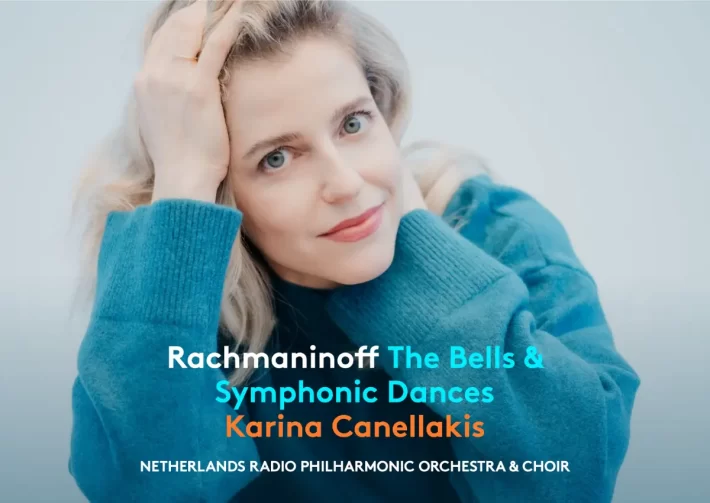
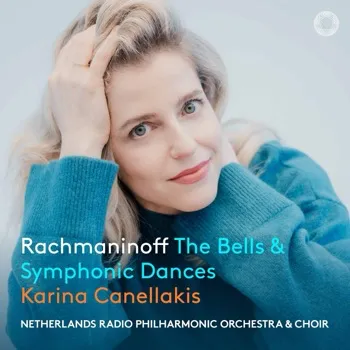
Karina Canellakis and her Netherlands Radio Philharmonic Orchestra continue to impress, aided significantly by stunning Pentatone sound. Offering an excellent sense of front-to-back perspective, the recording comfortably accommodates a wide dynamic range.
Having recorded extensively in Prokofiev and Shostakovich, the Dutch ensemble boasts a convincing Slavic twang. Even if their strings lack the sheer tonal heft of Evgeny Svetlanov’s USSR State Symphony Orchestra or Pavel Kogan’s Moscow State Symphony Orchestra, there is ample compensation from the brass. Their power and volume never devolve into the blaring characteristic of those Soviet performances, nor do the horns ever duplicate the distracting vibrato found in earlier readings.
Revisiting Vasily Petrenko’s recent recording of The Bells with the Royal Philharmonic Orchestra (review), one might suggest that performance finally affirmed Sergei Rachmaninoff‘s belief that it was his finest work. Canellakis achieves the exact same feat here. Throughout the first three movements, she adopts a marginally slower pace than Petrenko, yet her shaping remains equally impressive, constantly serving the dramatic expression of the text.
The Netherlands Radio Choir, Balanced well-forward, functions as an integral part of the action. Their tuning and diction are more than a match for their British colleagues, even if neither chorus captures the raw intensity of the Mariinsky Theatre Chorus on Gianandrea Noseda’s Chandos recording. A quicker tempo would have been preferable for The Loud Alarm Bells; focusing heavily on clarity and unanimity, this reading misses the frenzied clamor heard in definitive recordings by Simon Rattle and Kirill Kondrashin.
Choosing between the vocal soloists of Petrenko and Canellakis proves exceedingly difficult. Tenor Dmytro Popov lends the first movement a bright, eager tone. In the second movement, soprano Kristina Mkhitaryan slightly edges out the competition; her sweeter tone brings a chaste tenderness to the mellow wedding bells. Stretching about a minute longer than Petrenko and Kondrashin, the final movement never turns maudlin. Alexander Vinogradov’s singing is deeply affecting, and the introverted, resigned playing of the gorgeous string melody in the coda signals a true sense of acceptance and peace.
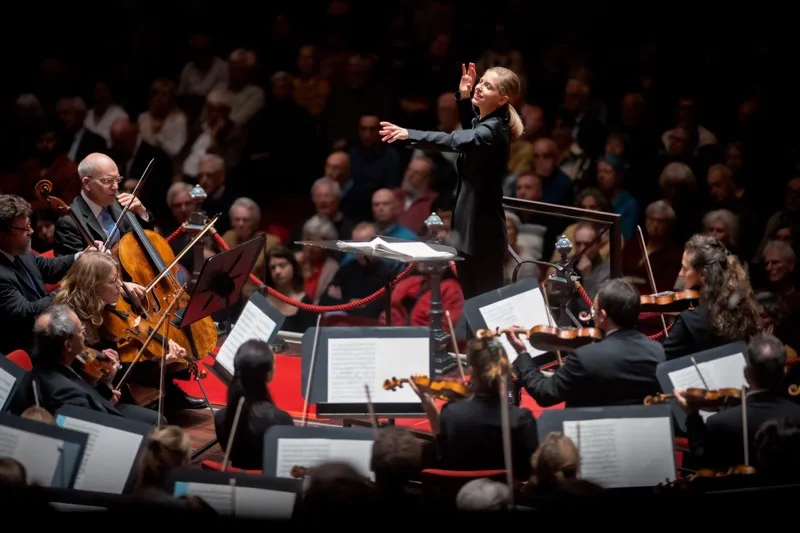
Karina Canellakis conducts the Netherlands Radio Philharmonic Orchestra. Photo © Marco Borggreve.
The Symphonic Dances emerges as slightly less successful, largely because it occasionally lacks the forward drive found in more compelling interpretations. Clocking in at just under twelve minutes, the first movement trails slightly behind the brisker paces set by Vladimir Ashkenazy, Petrenko, and Yannick Nézet-Séguin. While this difference appears insignificant on paper, those earlier readings possess greater urgency and slightly sharper articulation. Nevertheless, Canellakis revels in the colorful orchestration. Sounding appropriately warm and forlorn, the saxophone solo is beautifully realized, and the recollection of a theme from the composer’s first symphony is rendered emotionally ambiguous, precisely as Rachmaninoff intended.
Proving much more convincing, the second movement features brilliantly navigated shifts in mood and color. Similar to the third movement of The Bells, however, the main climax feels slightly too controlled, missing the emotional rawness present in rival accounts. Needing more urgency, the final movement still boasts undeniable excellence in playing and sound engineering.
It is difficult to recall another performance where the softer middle section is attended to with such care and conviction, leading one to wonder if the conductor views this passage as a point of emotional catharsis. Unfortunately, this focus negatively impacts the subsequent section, where trumpets blast the Dies irae theme over gut-wrenching chords.
When this darkness is answered by a quote from the composer’s All-Night Vigil—suggesting the fear of death is defeated by the promise of faith—the theological battle requires far more cataclysmic power than it receives here. Fortunately, the coda brings greater drive, culminating in window-rattling final bars and a spectacular gong stroke that resonates for over thirteen seconds.
Rounding out the release are excellent program notes, which include an introductory essay by the conductor alongside full texts and translations. Offering a fabulous performance of The Bells and an enjoyable rendition of Symphonic Dances, all captured in audiophile sound, this album comes warmly recommended despite minor caveats.
Album Details |
|
|---|---|
| Album name | Rachmaninoff: The Bells & Symphonic Dances |
| Label | Pentatone |
| Catalogue No. | PTC5187523 |
| Artists | Karina Canellakis (conductor); Netherlands Radio Philharmonic Orchestra & Choir; Kristina Mkhitaryan (soprano), Dmytro Popov (tenor), Alexander Vinogradov (bass) |